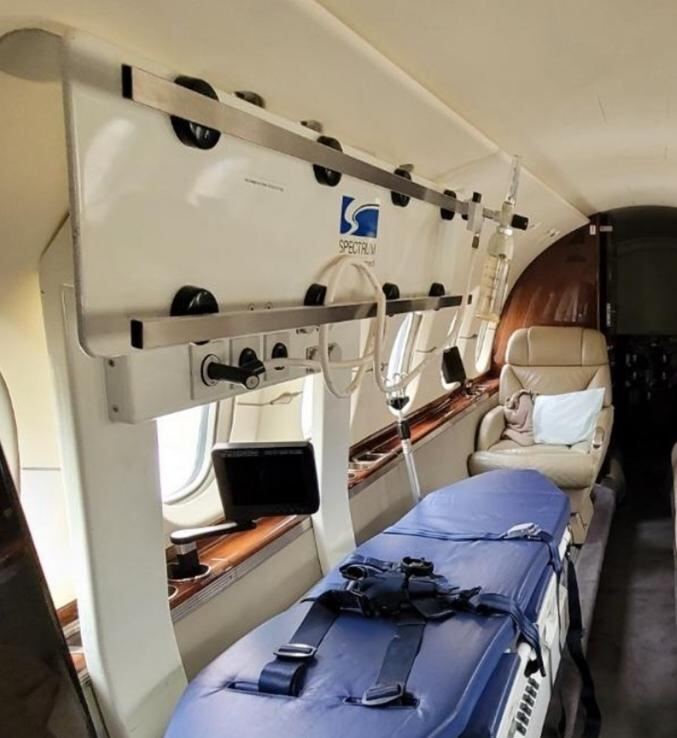
ICU-configured air ambulance interior with stretcher, monitors and ventilator for medical evacuation
    24/7 Operations Desk · Active Now

    Aviall Air Rescue · 24/7 Medical Evacuation

    Air Ambulance & Medevac Flights: ICU Care at 38,000 Feet

    ICU-configured aircraft, retrieval doctors and flight nurses, and door-to-door coordination from referring facility to receiving hospital. Operated 24/7 across the Asia-Pacific region and worldwide on repatriation.

    International air ambulance · medevac flights · ICU air ambulance · emergency medical evacuation · patient repatriation · neonatal, paediatric and adult retrieval, operated by clinical and aviation teams together.

    2 hr
    Plan-confirm target
    ICU
    Clinical configuration
    APAC+
    Region of strength
    24/7
    Operations & clinical desk

    What air ambulance and medevac services actually are

    Air ambulance, also called medevac, medical evacuation or aeromedical retrieval, is the use of an aircraft to move a patient who requires a level of clinical care that cannot be safely provided where they currently are. The aircraft is configured with the same monitoring, ventilation and infusion capability as a hospital intensive care unit, and is staffed by a retrieval doctor and a flight nurse with critical care training.

    Air ambulance flights cover the spectrum from inter-hospital transfers within a country, through regional retrievals out of remote work sites and outer islands, to long-haul international medical repatriation back to a patient's home country. The clinical objective is the same in every case, the patient leaves the originating facility no less stable than when they arrived, and lands at the receiving facility ready for handover into definitive care.

    Aviall Air Rescue is Aviall Group's medical division, operating across the Asia-Pacific region and worldwide on repatriation. Missions are coordinated 24/7 by a joint clinical and operations desk, with retrieval medical teams and aircraft drawn from a vetted operator pool sized for the case.
    When an air ambulance is the right answer

    The decision to move a patient by air ambulance rather than a scheduled commercial flight, ground ambulance or a non-medical charter is a clinical one, taken by the treating team and the retrieval doctor together. The most common situations in which air ambulance is the only safe option are:

    • The patient is critically ill or injured and requires continuous monitoring and intervention en route, ventilated, on vasoactive infusions, post-operative ICU, severe trauma, severe burns
    • The patient is medically stable but cannot tolerate the cabin environment of a commercial flight, uncontrolled cardiac, respiratory or neurological conditions, late-stage pregnancy with complications, infectious risk that cannot be managed in a public cabin
    • The originating facility cannot provide the level of care required and the closest appropriate facility is hours of flying time away, typically remote work sites, outer islands and regional hospitals
    • The patient requires transfer to a specialist centre, paediatric or neonatal ICU, burns, transplant, cardiac surgery, neurosurgery, ECMO
    • The patient is overseas, requires repatriation to their home country for ongoing care, and cannot fly commercially even with medical escort

    International medical evacuation and repatriation

    International medical evacuation and repatriation is the largest single category of long-haul air ambulance work. The patient, typically an expatriate, traveller or seafarer, has had an unexpected illness or injury overseas and needs to be moved either to a specialist facility in a third country, or back to their home country for ongoing definitive care under their normal medical and insurance arrangements.

    These missions involve coordination across multiple jurisdictions: the treating facility, the patient's insurer or assistance company, immigration and customs at the originating country, overflight and landing permits along the route, an appropriate receiving facility in the destination country, and ground ambulance at both ends. We hold standing relationships with the major medical assistance companies, insurers and embassies that allow these threads to be pulled together inside the clinical window.

    Aircraft selection on long-haul international medical evacuation is driven by range, cabin pressure profile and clinical configuration. Long-range business jets configured with a single ICU stretcher are the most common platform for trans-continental and trans-oceanic legs; for multi-patient moves and very long range we use larger turbine and jet platforms.

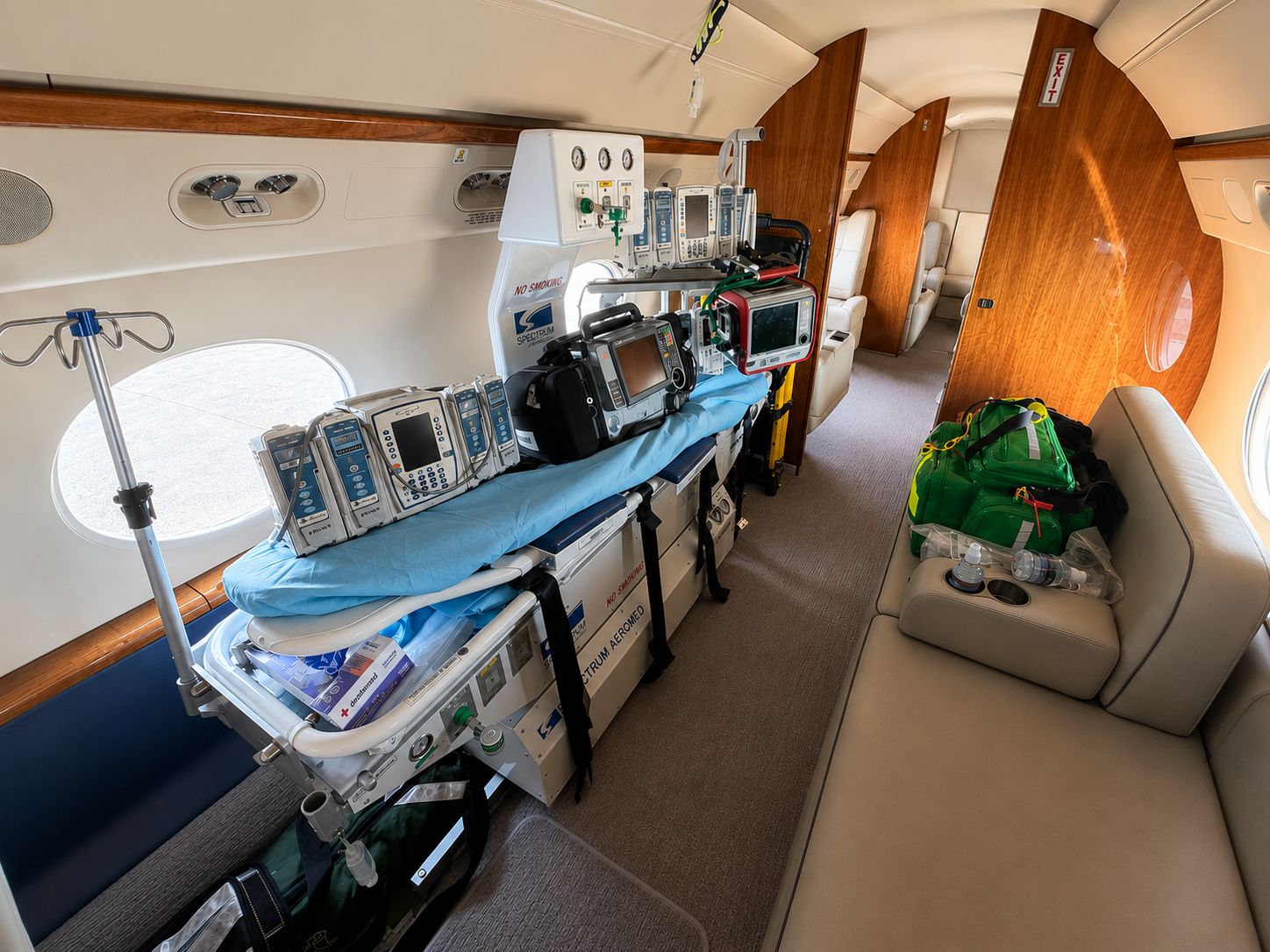
    ICU air ambulance, clinical configuration

    An ICU air ambulance is not a stretcher in a passenger cabin. The aircraft carries the equipment, drugs and consumables needed to manage a critical care patient through the entire mission, including positioning to the originating field, time on the ground, the flight to the receiving field, and handover.

    • Multi-parameter monitoring, ECG, SpO2, NIBP/IBP, capnography, temperature
    • Transport ventilator capable of full ICU modes including pressure-controlled and pressure-support ventilation, with FiO2 and PEEP control
    • Multiple syringe and infusion pumps for vasoactive, sedative and analgesic infusions
    • Defibrillator with pacing, suction, oxygen sized for the mission profile, and full airway and intubation kit
    • Mission-specific drugs including induction, sedation, paralysis, vasoactive, antibiotic, anti-arrhythmic, anti-emetic and reversal agents
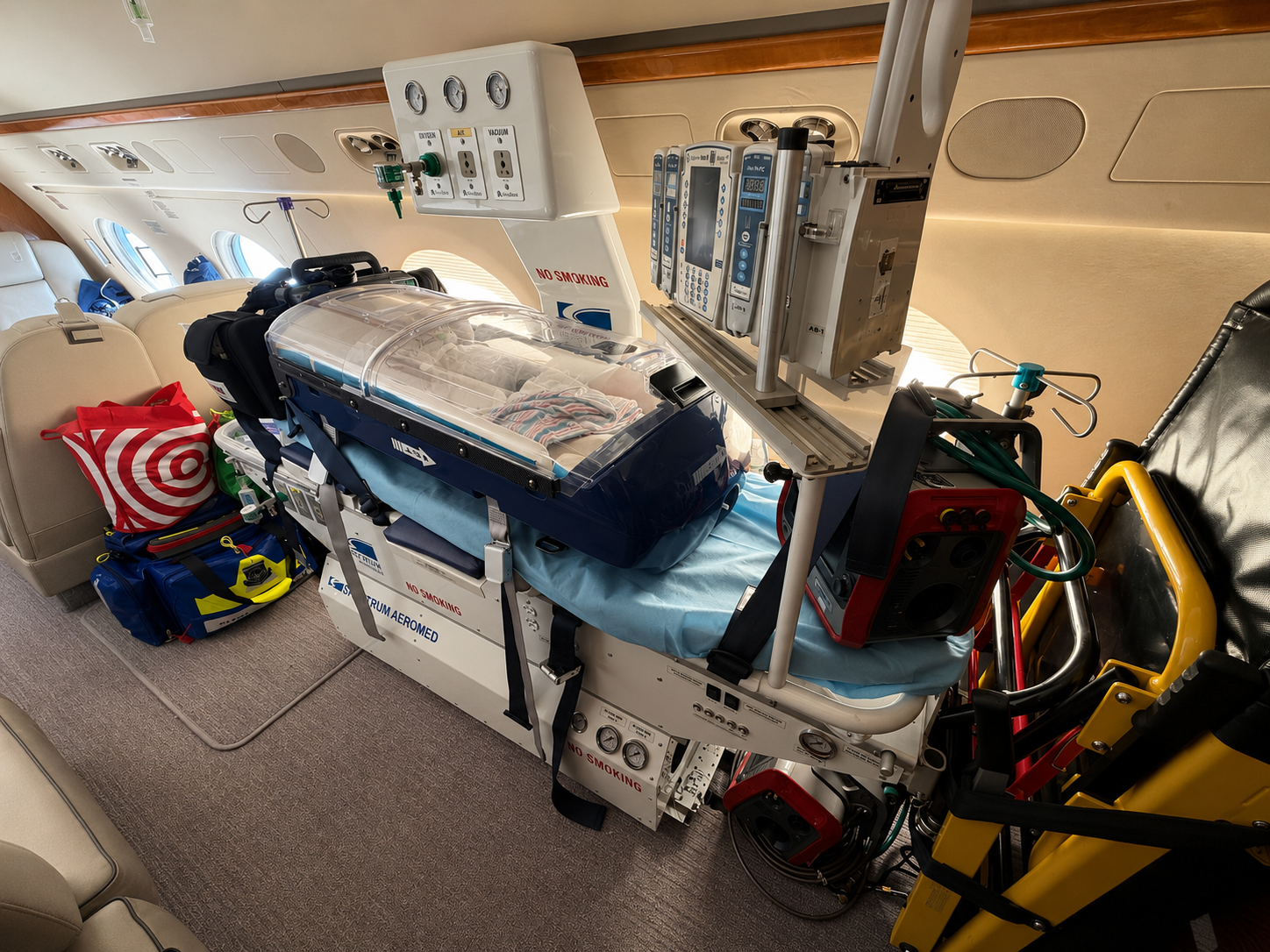
    • Specialised configurations available, neonatal incubator, paediatric, ECMO transport, balloon pump, IABP, isolation pod for highly infectious cases

    How a medevac flight is coordinated

    A typical medevac coordination begins with a clinical referral, from a treating physician, a medical assistance company on behalf of an insurer, a corporate medical adviser, or a foreign affairs department. The retrieval doctor speaks directly with the treating team to agree on transfer thresholds, the clinical configuration required, and any drugs or equipment that need to be carried in addition to the standard ICU loadout.

    In parallel, the operations desk works the aviation threads, aircraft selection from a pool of operators inside workable positioning radius, crew duty position, overflight and landing permits, customs and immigration arrangements at both ends, ground ambulance at both ends, and a confirmed receiving facility with the appropriate clinical capability and bed availability.

    Most threads are worked simultaneously rather than sequentially. The aircraft does not wait for the receiving facility, the receiving facility does not wait for the permits, and the permits do not wait for the medical team. The objective is that every component reaches readiness at approximately the same time, and the patient is on the aircraft as soon as the clinical handover at the originating facility is complete.

    Asia-Pacific operational depth

    The Asia-Pacific region is operationally distinctive, long ocean legs, limited diversion fields, runway and pavement constraints in the outer Pacific, biosecurity and customs particularities in Australia and New Zealand, and a clinical environment that varies substantially between major Australian, Singaporean and Hong Kong tertiary centres and the regional and remote facilities that act as the originating point for most of the work.

    Aviall Air Rescue's operational depth in this region is built around standing relationships with the operators, handlers, fuel suppliers and after-hours customs and immigration desks at the airports the work actually goes through, not just the major hubs. That depth is what allows short-notice clearances and after-hours arrivals to come together inside the clinical window.

    Pricing and payer arrangements

    Air ambulance missions are quoted per mission. The price reflects aircraft type and range required, total block hours including positioning, the clinical team and configuration, fuel, permits, ground handling and ambulance at both ends, and the receiving facility arrangements where we coordinate them.

    The vast majority of international air ambulance work is paid for by insurance, travel medical insurance, expatriate medical insurance, corporate medical and security cover, or a medical assistance company on behalf of one of those. We work directly with the major assistance companies and insurers and most missions are arranged on guarantee of payment rather than card-up-front. For private-pay and self-funded missions we arrange against bank transfer or guarantee.

    Indicative ranges: short-haul intra-country medevac typically sits in the low tens of thousands; regional Asia-Pacific medevac in the mid-tens to low six figures; long-haul international repatriation from Asia-Pacific to Europe or North America in the mid to high six figures depending on aircraft, routing and clinical complexity.

    What's covered in every air ambulance mission

    ICU-Configured Aircraft

    Stretcher, monitor, ventilator, infusion pumps, defib, oxygen and full airway kit. Neonatal, paediatric and ECMO available.

    Retrieval Doctor & Nurse

    Critical-care trained clinical team matched to the case. Clinical handover from referring team before launch.

    End-to-End Coordination

    Treating team, insurer, permits, customs, ambulance and receiving hospital, all worked in parallel by one desk.

    Worldwide Repatriation

    Long-haul jet platforms for trans-continental and trans-oceanic medical repatriation back to home country.

    Insurer-Direct

    Standing relationships with the major medical assistance companies and insurers. Guarantee of payment, not card-up-front.

    Specialised Configurations

    Neonatal incubator, paediatric, ECMO transport, IABP, isolation pod for highly infectious cases.

    Urgent charter? Our ops desk is staffed 24/7.

    Aircraft options within the hour and a written quote with an indicative wheels-up window.

    Mission examples · Illustrative

    What this looks like in operation

    Representative mission profiles drawn from recurring work. Identifying details — operators, hospitals, routes, aircraft tail numbers, are intentionally omitted.

    International · Repatriation

    Long-range stretcher repatriation across the Pacific

    A complex case with ventilator and infusion support required movement from a regional Pacific facility back to a domestic tertiary centre. Aviall configured a long-range jet with a critical-care medical fit-out, coordinated bed-to-bed handover with both treating teams, and managed customs and immigration at each stop.

    Outcome

    Bed-to-bed transfer completed without clinical deterioration en route.

    Neonatal · Critical

    Neonatal transfer to a tertiary paediatric centre

    A neonate requiring escalated care had to be moved from a regional hospital to a metropolitan paediatric tertiary centre. Aviall coordinated an aeromedical aircraft and a specialist retrieval team, with isolette-compatible loading and parent transit on the same airframe.

    Outcome

    Patient delivered to receiving NICU within the clinical window agreed by both teams.

    Remote · Mining medevac

    Trauma extraction from a remote mine site

    An incident at a remote mine site required immediate movement of a trauma patient to a metropolitan trauma centre. Aviall launched on the standing medevac protocol, with a clinical team mobilised in parallel and the receiving trauma team pre-briefed before take-off.

    Outcome

    Patient on the operating table at the receiving centre well inside the planned window.

    Group medical · Disaster

    Multi-patient evacuation after a regional event

    Following a regional medical surge, an insurer required several patients moved out of an under-resourced facility on a single mission. Aviall configured a larger airframe with multiple stretcher positions, a senior medical lead and ground ambulance staging at both ends.

    Outcome

    All patients transferred safely on a single rotation; receiving facility briefed before arrival.

    Commercial repatriation

    Stretcher case on scheduled wide-body

    Where the clinical picture allowed, Aviall arranged a stretcher booking on a commercial wide-body service with a medical escort, including airline approvals, MEDIF clearance, oxygen calculations and ground handover.

    Outcome

    Cost-effective repatriation completed without the need for a dedicated airframe.

    Organ transport

    Time-critical transplant logistics

    A transplant programme required time-critical movement of a viable organ between two metropolitan centres with a hard ischaemic window. Aviall held an aircraft on standby, coordinated tarmac transfers at both ends and ran a flight-following bridge with the surgical team.

    Outcome

    Organ delivered inside clinical viability window; recipient surgery proceeded on schedule.

    Air ambulance, capability matrix

    Light Jet (Learjet, Citation)
    Single stretcher · 2,500-4,500 km · regional and short-haul medevac
    Mid / Super-Mid Jet (Hawker, Challenger)
    Single stretcher · 5,500-7,000 km · regional and trans-continental medevac
    Long-Range Jet (Gulfstream, Global)
    Single stretcher · 11,000+ km · trans-oceanic and intercontinental repatriation
    Turboprop (King Air)
    Single stretcher · short / unimproved fields · remote site retrieval
    Clinical Configuration
    ICU monitor, transport ventilator, multi-pump infusion, defib, full airway and DG-compliant oxygen
    Specialised Loadouts
    Neonatal incubator · paediatric · ECMO · IABP · isolation pod for infectious cases
    Plan-Confirm Target
    2-hour operational target from enquiry to confirmed plan covering aircraft, clinical configuration and indicative wheels-up window

    FAQ

    Frequently Asked Questions

    Air ambulance is quoted per mission. Indicative ranges: short-haul intra-country medevac in the low tens of thousands; regional Asia-Pacific medevac in the mid tens to low six figures; long-haul international repatriation from Asia-Pacific to Europe or North America in the mid to high six figures. The exact number depends on aircraft, routing, clinical configuration and time on the ground.

    Why operators, brokers and end clients keep calling back

    Credibility built on operational discipline, not marketing

    "Single point of clinical accountability from the call to bed-to-bed handover. Our retrieval team had everything they needed before wheels-up."

    — Aeromedical retrieval lead · Tertiary hospital network

    "The case management discipline matched our internal standards. That is unusual in the assistance market."

    — Operations director · International medical assistance company

    "Aircraft selection was driven by the patient's clinical picture, not by what was on the apron. That is the right way around."

    — Critical-care physician · Repatriation case

    Need an air ambulance arranged?

    Call our 24/7 operations desk. The fastest path is a clinical handover from the treating team or assistance company to our retrieval doctor on the same call. We work clinical and operational threads in parallel from that point.

    Call 24/7 Ops · 1800 796 769

    Prefer to talk? Call 1800 796 769 — answered 24/7.