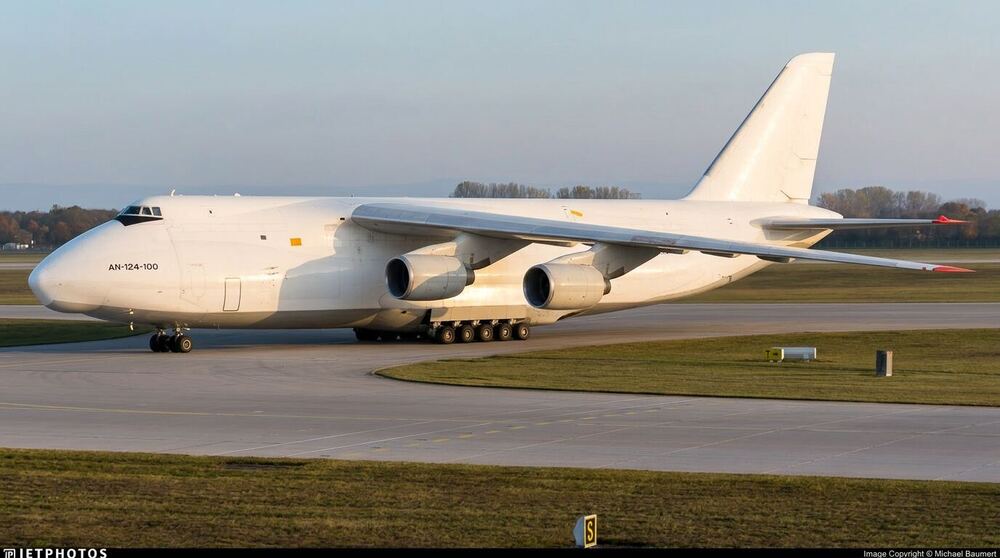
It comes up most weeks. A maintenance controller has an AOG widebody on one side of the world, a spare engine sitting on a stand on the other, and a charter desk on the phone trying to scope the lift. The first instinct from the customer is often 'get me an Antonov'. Sometimes that is the only correct answer. Just as often a 747F is faster and roughly half the price, and the AN-124 conversation is a hangover from how this kind of work used to get done.
Start with the engine and its stand, not the aircraft
The first call we make is to confirm engine type, full dimensions including the transport stand, and total weight. Most current widebody engines (GE90, GEnx, Trent 1000, Trent XWB, PW1100G on the narrowbody side) will pass through the main-deck cargo door of a 747-400F or 747-8F when sitting on a standard OEM transport stand. The 747-400F's main-deck door is roughly 3.4 m high by 3.7 m wide; clearance to a fan-cowl-on QEC engine is tight but workable on most variants. Bare cores are easy. QEC builds with cowls fitted are where it gets marginal.
The AN-124 becomes the right aircraft when the engine plus its stand exceeds the 747F's main-deck envelope (some GE9X scenarios, some custom test or development engines), when the stand is a non-standard workshop cradle that cannot be swapped in time, when the customer wants to fly the engine and its full supporting kit (toolkits, BFE, slings, ground equipment) as one consolidated lift, or when destination access rules the 747F out.
Range and routing can flip the answer
On long lanes (Europe to East Asia, US to the Middle East) a 747-8F with full payload typically does the job in a single tech stop where the AN-124 is two stops, sometimes three depending on payload split. Wheels-down at destination matters more than wheels-up at origin. A slower start can still arrive several hours sooner.
Where the AN-124 reliably wins on routing is access. Onboard cranes (two 20-tonne overhead cranes) mean it does not need handling equipment at destination. Lower pavement loading and a tougher undercarriage open up military bases, mining strips and constrained MRO airports where a 747F simply cannot land. If the destination is a 1,800 m strip in a difficult country, the conversation is over: it is going on the Antonov, or it is not going.
What usually decides it: availability on the day
There are roughly forty active 747F-class freighters worldwide, and a much smaller number of AN-124s in commercial service today, with significant operational and political constraints on parts of that fleet. Most of the 747F population is committed to scheduled, ACMI or block-space programs and only releases capacity at the margin. AN-124 capacity tends to be locked into project-lift cycles for energy, aerospace, satellite and defence customers months ahead.
On any given AOG day the theoretical question of 'which aircraft is the right tool' often collapses to 'which of the right tools is actually free inside the recovery window'. A working desk holds that availability picture more or less in real time, which is what determines the wheels-up window the customer can actually rely on.
Cost
If both aircraft are physically and operationally viable, the AN-124 will typically come in 50-100% above the 747F all-in, depending on positioning. That premium is sometimes obviously worth it: onboard cranes save the cost and time of mobilising heavy lift gear at a remote destination, the engine moves with all its support kit on a single MAWB, and in some windows the AN-124 is the only freighter that can actually be released. In other windows the customer is paying Antonov money for a job a 747F would have done faster.
How we work the call
Roughly in this order. Confirm engine type, dimensions on the stand, total weight and packaging. Test that against the 747F main-deck door first. If it fits and a 747F is released inside the window, that is usually the answer unless the customer has a clear reason to consolidate the lift. If the 747F is not viable, not available, or destination access rules it out, work the AN-124 and be honest with the customer about the cost and the time difference.
The useful question is rarely 'AN-124 or 747F in the abstract'. It is 'what does this specific engine on this specific stand need, and what can actually be released to move it inside the window we have'.