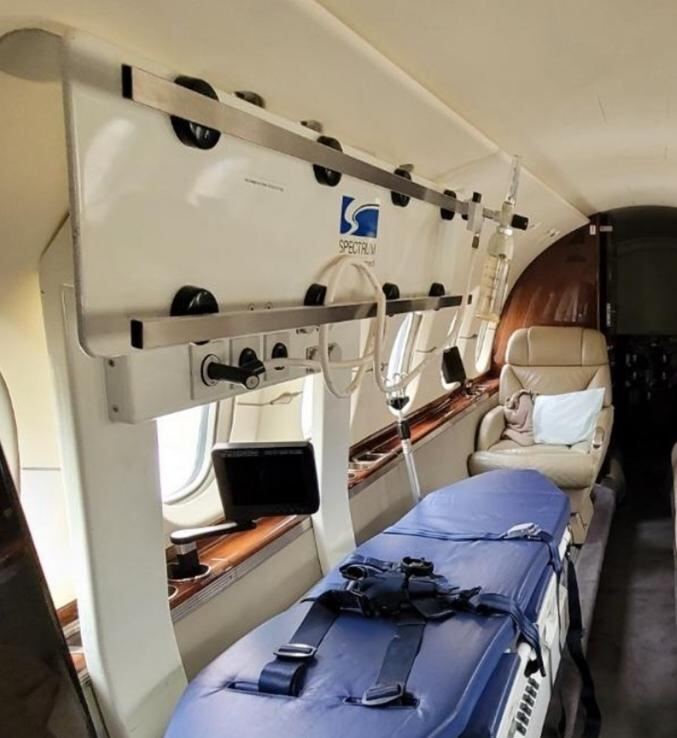
Medical evacuation insurance is the cover that pays for moving a patient from where they fall ill to where they can be properly treated, and, where required, home again. For international travellers and expatriates it is often the single most important line in a travel or health policy, and also the one least understood until it is needed. This guide explains what the cover actually does, what separates a strong policy from a weak one, and what happens operationally once a claim is activated and an air ambulance is launched.
What medical evacuation insurance covers
At its core, the cover pays for the transport and clinical care involved in moving a patient who cannot be treated locally to an appropriate facility. In practice that can mean a road ambulance to a regional airport, a chartered air ambulance with a clinical crew, commercial stretcher transport on a scheduled flight, or a combination of all three across a single case. The policy is paying for the movement and the in-transit care, not the hospital treatment itself, which usually sits under a separate medical-expenses benefit.
The distinction matters because the two benefits can have very different limits. A policy can carry a generous medical-expenses limit and a thin evacuation limit, which is a problem precisely when evacuation is the expensive part. An international air ambulance mission can run well into six figures, and a low evacuation cap can leave a patient or family exposed at the worst possible moment.
Why bed-to-bed cover is the clause to look for
The strongest evacuation policies are written on a bed-to-bed basis. That means the cover runs continuously from the hospital bed at origin to the hospital bed at the destination, including every link in between: the planeside transfer, the clinical crew, the flight, customs and immigration handling for an unscheduled medical arrival, and the receiving ground ambulance.
Weaker policies cover only the flight itself, leaving gaps at either end where the patient is between a bed and an aircraft. Those gaps are exactly where delays and unbudgeted costs appear. When reading a policy, the question is not only how much it pays but where its responsibility starts and stops.
Repatriation: getting home, not just to the nearest hospital
Evacuation and repatriation are related but different. Evacuation moves a patient to the nearest facility that can treat them. Repatriation moves a stabilised patient back to their home country for ongoing care or recovery. Many travellers assume one policy covers both; not all do.
Repatriation matters most for expatriates and long-stay travellers, where the patient's long-term care, family and health system are in another country. A policy that funds evacuation to a regional hospital but not repatriation home can leave a recovering patient stranded far from their support network. Look for explicit repatriation wording, including repatriation of mortal remains, which is a distressing but real consideration for any honest policy review.
What to check before you buy
A short checklist separates serious cover from marketing copy:
Evacuation limit: is it high enough to fund a genuine international air ambulance mission, not just a regional transfer?
Bed-to-bed wording: does the cover run continuously from origin bed to destination bed, or only the flight?
Repatriation: is repatriation to the home country explicitly included, separate from evacuation to the nearest facility?
Assistance company: is there a 24/7 medical assistance line, and who decides when and how an evacuation happens?
Region and activity exclusions: are remote work sites, certain countries, or activities such as offshore, mining or adventure travel excluded?
Pre-existing conditions: how are they handled, and what disclosure is required to keep the cover valid?
What happens when the policy is activated
When a serious medical event occurs abroad, the assistance company named in the policy is normally the first call. They assess the clinical picture, confirm cover, and authorise the evacuation. From there the operational work begins, and it looks much like any other air ambulance mission: an appropriately configured aircraft is sourced inside a workable positioning radius, a clinical crew is activated, permits and customs are arranged at both ends, and a receiving facility is confirmed before the patient is moved.
The smoothest activations are the ones where the insurer, the assistance company and the air ambulance provider already work to a common process. In genuine emergencies, verbal authorisation to begin planning is often given so aircraft and crew sourcing can start while the financial paperwork is completed in parallel, rather than waiting for closed paperwork before any movement begins.
Where Aviall Group fits
Aviall Group operates ICU-capable air ambulance and international medical evacuation across the Asia-Pacific, working directly with insurers and medical assistance companies when a policy is activated. The same 24/7 operations desk that runs the clinical and aircraft side also coordinates the permits, customs and receiving-facility arrangements that a bed-to-bed claim depends on.
For travellers and expats, the practical takeaway is simple: read the evacuation and repatriation clauses before you travel, not after something goes wrong. For background on how the missions themselves are run, see the air ambulance and medevac pillar at /air-ambulance-medevac, the international medical evacuation guide at /international-medical-evacuation, and the related case studies in this insights library. For an activation, the desk is reachable on 1800 796 769, 24 hours.