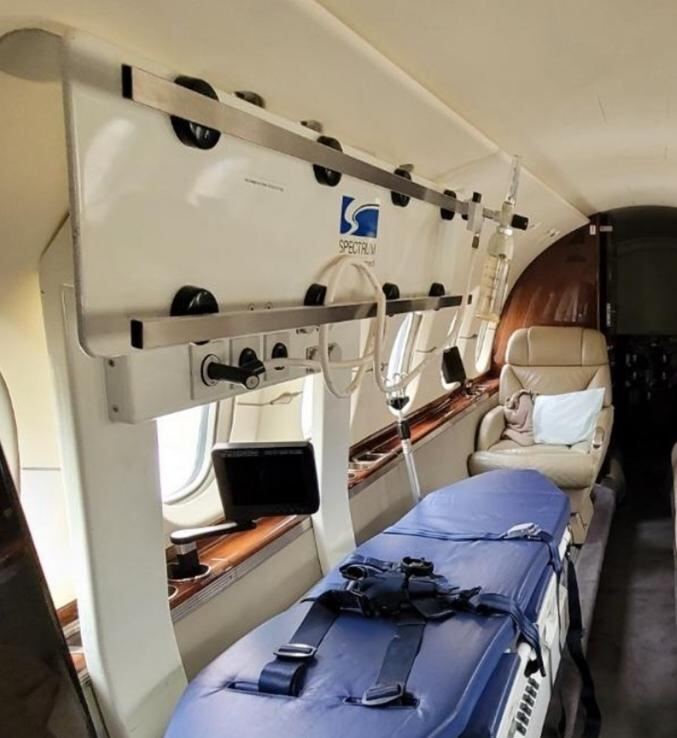
A medevac flight, short for medical evacuation flight and also known as an air ambulance, is a fixed-wing or rotary aircraft configured to transport a patient who needs medical care during the journey. The mission combines a clinical retrieval team and a flight crew in one operation. The aim is to move a patient from where they are to a facility that can give them the level of care they need, in a clinically safe condition, as quickly as the case allows.
The phrase covers a wide range of missions: a stable patient on a routine inter-hospital transfer, a deteriorating patient on full ICU support across an ocean, a paediatric retrieval onto a tertiary children's hospital, or a multi-trauma case lifted from a remote work site. The structure of the mission is the same across all of them. The differences are in the aircraft, the clinical loadout and the urgency.
Who is on a medevac flight
A typical international or long-range medevac team includes a retrieval doctor (usually with intensive care, emergency medicine or anaesthesia background), a flight nurse (with critical care experience), and the flight crew (captain and first officer, sometimes a third pilot for long sectors). Some missions add a paramedic, a respiratory therapist or a paediatric specialist depending on the case. The receiving hospital is in contact throughout for clinical handover.
How a medevac mission is structured
Every medevac mission Aviall arranges follows the same operational structure, regardless of geography:
First call. The duty phone receives the request, usually from a medical assistance company, an insurer, a hospital, a corporate medical desk or a family member acting through a broker. The clinical picture is captured. Verbal authorisation to begin operational planning is normally given even before financial paperwork is closed, because the clinical window does not wait for procurement.
Clinical assessment. The retrieval team contacts the sending facility or site medic. They build a clinical picture, agree the transfer thresholds (the parameters under which the patient can safely fly), and decide whether the patient needs ICU loadout, paediatric loadout, infectious-disease isolation, or any other specialist configuration.
Aircraft sourcing. The operations desk sources the aircraft based on range to destination, runway suitability at both ends, configuration available, and crew duty position. An aircraft already configured for ICU work is normally preferred over one that needs to be reconfigured.
Permits and clearances. Overflight and landing permits at every country involved, customs and immigration arrangements for an unscheduled medical arrival, and ground ambulance at both ends are coordinated in parallel with the aircraft preparation.
Patient handover at origin. The clinical team meets the patient planeside or at the hospital. Clinical handover from the sending team is completed before the patient is moved onto the aircraft stretcher.
The flight. In cruise, the retrieval doctor manages the patient against the agreed transfer thresholds. The flight crew stays in contact with the receiving end and adjusts routing if needed.
Arrival and onward transfer. Customs clearance for the patient and clinical crew is normally pre-arranged so the ground ambulance can connect to the receiving hospital with minimal delay.
What aircraft are used
Aircraft selection is a clinical and operational decision combined.
Light jets and turboprops (King Air, Learjet 35, Citation class) for short Pacific-island, regional Australian or trans-Tasman sectors. Range typically up to 2,500 km, two patients maximum, full ICU loadout possible.
Mid-size and super-mid jets (Challenger 350, Hawker class) for longer Asia-Pacific or Asia-Australia sectors. Range up to 5,500 km, ICU loadout standard.
Long-range and ultra-long-range jets (Global, Falcon, Gulfstream class) for trans-Pacific, Australia-Europe or Australia-North America missions. Range above 10,000 km, full ICU including ventilator, infusion pumps, monitoring and resuscitation.
Wide-body airliners reconfigured with stretcher and ICU pod for cases requiring extended-family travel or extreme isolation.
See the Asia-Pacific medevac page for aircraft commonly used in the region and the aircraft comparison for technical detail.
What it costs
Medevac pricing is built against the mission. Short Pacific-island sectors on a King Air typically range from USD $25,000 to $60,000. Long-range trans-Pacific or Asia-Australia transfers on a Challenger or global-class jet with full ICU loadout typically range from USD $90,000 to $250,000-plus. See air ambulance cost for the full breakdown of clinical and operational drivers.
Who pays for a medevac flight
Medevac is most often paid by travel insurance, corporate medical cover, government emergency repatriation programs, or private payment by the patient or family. The insurer or assistance company is normally the first point of contact for the operations desk. Where there is no insurer, Aviall works with the family or corporate sponsor directly.
Frequently asked questions
How fast can a medevac flight be arranged?
For Asia-Pacific missions, wheels-up within four to eight hours of confirmed authorisation is typical for a properly scoped case. Long-range trans-Pacific or Australia-Europe missions normally need eight to twenty-four hours because of permits, crew duty and clinical preparation. Genuinely critical cases can move faster when authorisation is given verbally and paperwork follows.
What is the difference between a medevac and an air ambulance?
In Australian and international usage the two terms are largely interchangeable. Medevac (medical evacuation) tends to imply a more urgent or longer-range mission, often international, while air ambulance is sometimes used for shorter inter-hospital transfers. Both refer to fixed-wing or rotary aircraft configured for in-flight medical care.
Can family members travel on a medevac flight?
Often yes, depending on the aircraft and the clinical case. Most light and mid-size jets used for medevac can carry one or two family members. Some clinical cases preclude additional passengers. The retrieval team confirms on a case-by-case basis.
Can a medevac flight refuse to take a patient?
Yes, on clinical grounds. If the retrieval team assesses that the patient cannot be safely flown, the mission is not launched. The decision rests with the retrieval doctor and is made against the agreed clinical transfer thresholds, not against operational pressure.