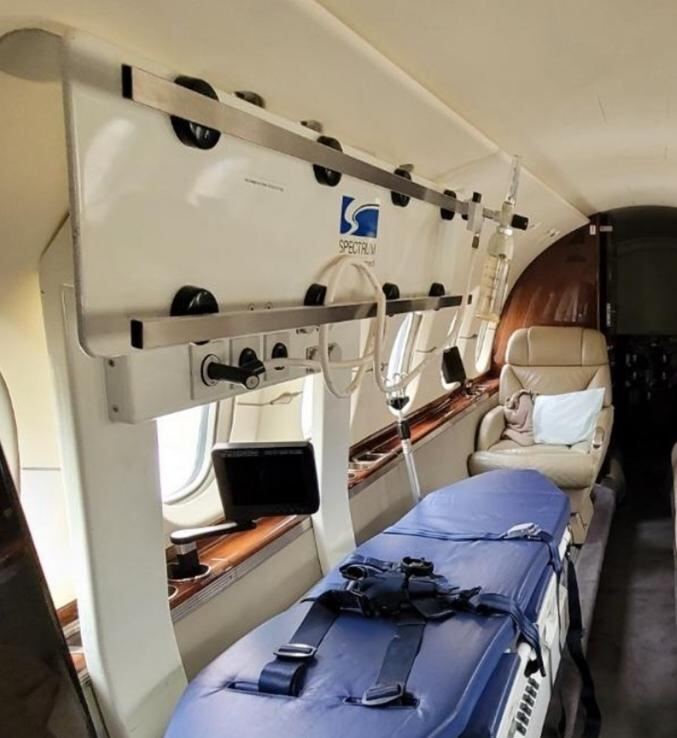
Medical interior of a fixed-wing air ambulance configured for ICU transfer
    24/7 Operations Desk · Active Now

    Singapore, Singapore · Medical Flight Operations

    Air Ambulance Singapore, 24/7 Medical Evacuation Flights

    For families, treating teams, insurers and assistance companies: ICU-grade air ambulance, neonatal and stretcher repatriation in and out of Singapore. Call 1800 796 769 for a costed option within the hour, one number, one accountable coordinator.

    Already have an RFQ prepared? Email charters@aviall.com.au

    24/7
    Medical desk
    <60 min
    Activation target
    ICU
    Clinical capability
    Bed-to-bed
    Handover model

    Speaking to someone is usually the fastest way to start.

    Our medical transfer desk is staffed 24 hours. You do not need complete information to make the first call, the current location of the patient and where they need to go is enough to begin.

    Patient information is treated as sensitive. Medical detail and uploaded reports go only to the clinical and operations coordinators handling the case, are never placed in web addresses, and are never shared with advertising or analytics platforms.

    Singapore operating conditions that shape the plan

    Singapore is the region's most dependable staging and technical-stop point, which is why it appears in so many long-range plans as a mid-point rather than a destination.

    For patient transfers, Singapore functions both as a receiving destination for tertiary care and as a mid-point for long-range repatriation, where crew change and refuelling are planned into the clinical timeline.

    • Changi (SIN/WSSS) operates 24 hours with strong handling capacity; Seletar (XSP/WSSL) is the dedicated business and general-aviation airport
    • Singapore is a major regional technical stop for long-range sectors, with reliable fuel, crew and maintenance availability
    • Slot and parking availability at Changi tightens in peak international waves
    • Regulatory processes are predictable, which shortens lead time relative to much of the region

    Air ambulance Singapore: ICU medevac configured around the patient

    Aviall is a charter and mission-management specialist, not a Singapore-based ambulance operator or a hospital. Aircraft and clinical teams are sourced and matched to each case, and the accreditation of whoever is assigned is disclosed to you in writing. If you need a local ground ambulance inside Singapore, a hospital's own retrieval service is the faster call. If a patient has to cross a border, into or out of Singapore, most often to or from Australia and New Zealand, that is the work Aviall runs.

    Missions operate from Singapore Changi (SIN/WSSS) and Seletar (XSP), with the airframe chosen against the clinical picture rather than a fixed fleet. Every case is run by a single accountable coordinator on a 24/7 desk: clinical teams, aircraft sourcing, ground ambulance staging, receiving-facility briefing and the diplomatic and customs clearances a cross-border case requires.

    When to call for a Singapore medevac or air ambulance

    Most calls reach us for one of three reasons: the airline timetable will not hold the clinical timeline, the patient needs a stretcher or full ICU, or the repatriation out of Singapore involves more coordination than a treating team can carry.

    • ICU-grade transfer with ventilator, infusion pumps, monitoring and clinical escort
    • Neonatal and paediatric transfer with isolette-compatible loading and specialist retrieval team
    • Cross-border repatriation with insurer or assistance company in the loop
    • Stretcher case on a commercial wide-body where the clinical picture allows
    • Multi-patient evacuation following a regional medical surge or incident
    • Time-critical organ transport with hard ischaemic windows

    ICU-grade aircraft and clinical configurations from Singapore

    We match the aircraft to the case: range for the sector, runway limits at both ends, the clinical fit-out needed, and the patient's tolerance for pressure changes. No fleet to fill.

    • Light jet, short-range, single-stretcher missions inside the regional Asia-Pacific
    • Midsize jet, extended range with full ICU fit-out, suited to inter-capital and trans-Tasman work
    • Long-range jet, international repatriation with ventilator and infusion support
    • Turboprop, strip-capable airframes for remote and mining-site retrieval
    • Commercial wide-body stretcher, cost-effective repatriation with airline approvals managed

    Singapore medevac coordination model, one accountable coordinator

    One person, start to finish. The coordinator who picks up the referral runs it to the receiving bedside, with the flight followed live and each clinical handover recorded.

    • 24/7 medical activation desk on a single number
    • Clinical lead in contact with the sending and receiving teams
    • Ground ambulance staged at origin and destination
    • MEDIF, oxygen calculations and airline approvals where commercial uplift is used
    • Customs, immigration and diplomatic clearances on cross-border missions
    • Insurers, assistance companies and families all deal with the same coordinator

    Seletar vs Changi: handling, hospital handover and ground logistics

    Most Singapore cases are hospital-to-hospital rather than scene retrievals. The clinical handover, not the flight, is what usually determines the timeline, so Aviall works the ground legs and the receiving-bed confirmation in parallel with aircraft sourcing.

    • Receiving-bed confirmation obtained before departure, so the patient is never launched into an unconfirmed admission
    • Ground ambulance staged planeside at Seletar (XSP) for medical movements, or at the Changi (SIN/WSSS) medical apron where the airframe or slot requires it
    • Written clinical handover at each interface, treating team to flight team, flight team to receiving team
    • Escorting family member seating arranged on the same airframe where the fit-out and weight allow
    • Immigration and Ministry-level clearances handled for inbound and outbound patients, including deceased repatriation on request
    • Insurer or assistance-company case file opened at referral and updated through to handover

    How a Singapore medevac runs, hour by hour

    Most Singapore cases follow the same sequence. Knowing it in advance helps treating teams, insurers and families judge what is realistic on the day.

    • First call, clinical picture, origin ward, destination and escort requirements captured on one call
    • Within the hour, aircraft options, clinical configuration and an indicative cost returned in writing
    • Activation, clinical team confirmed, receiving bed accepted, Seletar or Changi handling and slots requested
    • Ground legs, ambulance staged planeside at origin and at destination, oxygen and equipment checked against the flight profile
    • In flight, continuous flight-following, coordinator reachable on one number for insurer and family updates
    • Bed-to-bed, written handover to the receiving team, case file closed with insurer-ready documentation

    Costs and cover for a Singapore medevac

    Cost is driven by airframe, distance and clinical fit-out rather than a fixed price list. Indicative ranges help set expectations while a firm quote is prepared.

    • Regional sectors within South-East Asia, typically low-to-mid five figures on a light or midsize jet
    • Singapore to Australia or New Zealand, mid five figures upward depending on ICU fit-out and crew duty limits
    • Long-range repatriation to Europe, the Middle East or North America, commonly six figures
    • Commercial stretcher or medical-escort repatriation, the lowest-cost option where the clinical picture allows
    • Insurer and assistance-company billing supported, with costings issued before commitment
    • No cost for the initial clinical and feasibility discussion

    Hospital-to-hospital transfers within Singapore and the region

    The majority of Singapore work is inter-facility: a patient stabilised in one tertiary centre needs to reach a specialist bed elsewhere, or an inbound patient needs an accepted admission before the aircraft is released. Aviall runs the clinical, ground and flight legs as one sequence so the ward-to-ward timeline holds.

    Regional legs out of Singapore are short in flight time but heavy in clearance work. Permits, slots, night-curfew restrictions and ambulance access at the far end usually dictate the schedule more than the sector length does, so those constraints are worked at referral rather than after activation.

    • Inter-facility transfer within Singapore with planeside or direct road handover, depending on the receiving centre
    • Specialist acceptance confirmed in writing, ICU level, isolation requirements and admitting consultant recorded before departure
    • Regional legs to Malaysia, Indonesia, Thailand, Vietnam and the Philippines with overflight and landing permits pre-cleared
    • Night-curfew and slot restrictions at regional fields checked against the clinical urgency, with alternates nominated
    • Isolation, infectious-disease and bariatric cases planned with the receiving facility's infrastructure in mind
    • Oxygen, power and equipment reconciliation across each leg so nothing is assumed between road and air

    Singapore permits, clearances and slot process, step by step

    Singapore is one of the most procedurally disciplined jurisdictions in the region. Nothing about a medevac is improvised here: landing permission, handling, ambulance apron access and immigration are each a separate approval, and the sequence matters more than the speed of any single step.

    Aviall runs those approvals in parallel with clinical planning so the aircraft is never waiting on paperwork and the paperwork is never waiting on a clinical decision that has already been made.

    • Landing permit lodged with the civil aviation regulator for the specific airframe, registration and mission profile, medevac cases are prioritised but still require the full submission
    • Airport slot and parking requested at Seletar or Changi, with an alternate nominated where the requested window is tight
    • Ground handling appointed at the chosen field, including planeside ambulance apron access approval, which is a separate clearance from the landing permit
    • Customs and immigration pre-notified for patient, escorting family and clinical crew, including crew visa status where the team is inbound from another country
    • Medical oxygen, controlled drugs and clinical equipment declared in advance, quantities and documentation reconciled against the flight profile
    • Overflight and landing permits for the onward or origin state worked at the same time on cross-border cases, so the whole routing clears together rather than leg by leg

    Air ambulance Singapore: receiving-facility handover

    Singapore's tertiary centres, both public and private, are well equipped to accept complex inbound patients, and each has its own admission and apron-transfer expectations. Aviall works to the receiving facility's process rather than a generic one.

    • Admitting consultant, bed level and ward identified and confirmed in writing before the aircraft is released
    • Private tertiary centres, typically insurer-funded admissions with pre-authorisation confirmed ahead of departure
    • Public tertiary and university-affiliated centres, admission routed through the receiving specialty and emergency pathway as that facility requires
    • Isolation or infectious-disease cases matched to a facility with the required infrastructure, confirmed before routing is fixed
    • Road transfer time from the chosen field to the receiving facility factored into oxygen and drug calculations
    • Written clinical handover completed at the bedside, not at the aircraft door

    How to choose an air ambulance company in Singapore

    Searches for air ambulance providers in Singapore usually happen under time pressure, and the market contains operators, brokers, hospital retrieval services and assistance companies that all present similarly. The questions below separate them quickly, and they are worth asking of Aviall as much as of anyone else. If a provider cannot answer them on the first call, the timeline they quote is unlikely to hold.

    • Who holds the operating certificate for the aircraft that will actually fly, and in which jurisdiction? Aviall states the assigned operator and its certificate with the aircraft option
    • Which clinical accreditation is the medical team and fit-out assessed against? Ask for the current certificate rather than a logo, Aviall provides it for you to verify with the issuing body directly
    • Is the quote bed-to-bed or airport-to-airport? Ground ambulance and receiving-facility coordination are where costs and delays usually hide. Aviall quotes bed-to-bed and names the variation triggers
    • Who owns the case end to end, and can you reach that person on one number at 3am? Aviall assigns a single accountable coordinator at referral, not a rotating queue
    • Is the receiving bed confirmed before the aircraft launches? A patient should never be flown into an unconfirmed admission, so written specialist acceptance is obtained first
    • What happens if the receiving bed is withdrawn or the patient deteriorates before departure, and who absorbs the cost of a stand-down?
    • Who lodges the landing permit, apron ambulance access and immigration notifications? These are three separate approvals in Singapore, and Aviall runs them in parallel with clinical planning
    • Will the documentation satisfy an insurer or assistance company? Case files are opened at referral and closed with insurer-ready handover reporting

    Accreditation and clinical standards on Singapore medical flights

    Buyers frequently search for specific accreditations such as EURAMI or CAMTS when comparing medical flight providers. These are genuine quality frameworks covering clinical staffing, equipment, training and governance, and accreditation is held by the operator and medical team, not by a broker or coordinator.

    Aviall's position is straightforward: the accreditation status of the operator and clinical provider assigned to a case is confirmed and disclosed to you in writing as part of the aircraft option, so you can verify it directly rather than take it on trust. Where a case requires a specific accreditation, that becomes a sourcing requirement rather than a preference.

    • Accreditation status of the assigned operator and clinical provider stated in writing with the aircraft option
    • Clinical crew composition confirmed against the case, retrieval consultant, ICU nurse, paramedic or neonatal specialist as the picture requires
    • Equipment fit-out reconciled against the clinical requirement, including ventilator, monitoring, infusion and oxygen calculations for the actual flight profile
    • Insurer or assistance-company documentation standards met where a case is funded under a policy
    • Specific accreditation requirements treated as a sourcing constraint when a policy or receiving facility mandates one
    • Verification encouraged, certificates are provided for you to check with the issuing body directly

    What families, treating teams and insurance coordinators each need

    A Singapore medevac referral usually comes from one of three directions, and each caller needs a different first answer. Aviall works to whichever seat you are in rather than pushing everyone through the same script.

    • Families, one number, plain-English answers on what is possible today, an indicative cost before any commitment, and a named coordinator who stays reachable through the flight
    • Treating clinicians, clinical feasibility, cabin-altitude and oxygen considerations, escort options and a documented handover, discussed clinician to clinician
    • Insurers and assistance companies, case file opened at referral, written costings, aircraft and clinical configuration options, and insurer-ready reporting through to bed-to-bed handover
    • Corporate and duty-of-care teams, employee retrieval from regional sites, escalation contacts and a single accountable owner for the movement
    • Receiving facilities, admitting consultant, bed level and arrival window confirmed in writing before the aircraft is released
    • Anyone unsure whether a medevac is required, no cost for the initial clinical and feasibility discussion

    Singapore medevac capability at a glance

    ICU air ambulance

    Ventilator, pumps and monitoring fitted to the patient's acuity, with escort to match.

    Neonatal & paediatric

    We check isolette loading against the specific airframe and mobilise a specialist retrieval team.

    International repatriation

    Long-range airframe, border and diplomatic clearances arranged, insurer reporting included.

    Commercial stretcher

    Scheduled wide-body stretcher, including airline medical clearance and oxygen planning.

    Remote retrieval

    Aircraft that can get into remote strips, including resource-sector airfields.

    Single coordinator

    One coordinator, reachable directly, for the whole transfer.

    Medical transfer & repatriation desk

    Request a medical transfer

    You do not need a complete clinical picture to contact us. Tell us where the patient is and where they need to go, and a coordinator will start assessing options, aircraft, clinical configuration, crewing, clearances and ground ambulance, while the rest of the information is still being gathered.

    Enough to start

    • Where the patient is now

      City or country, and the facility type if you know it

    • Where they need to go

      City, country, or receiving hospital if already arranged

    • Rough timing

      Today, within 24 hours, or later this week

    • How they are travelling

      Seated, wheelchair, stretcher, or intensive care, an estimate is fine

    Helpful, but can follow

    • A medical report, discharge summary or fit-to-fly assessment, uploaded securely
    • Treating team or transfer-desk contact, so our clinical coordinator can speak with them directly
    • Insurer, assistance company or funding arrangement, if one applies
    • Receiving hospital acceptance, where that is still being organised

    Clinical acceptance and aircraft availability are confirmed after review by the clinical team and the receiving facility. Contacting us does not by itself confirm a flight, a crew or acceptance of the patient.

    Or email medical reports and case detail to charters@aviall.com.au

    Privacy: patient details and uploaded reports are handled as sensitive information, stored in restricted storage, and passed only to the coordinators and clinicians working the case. They are never written into web addresses, advertising platforms or analytics events.

    Urgent charter? Our ops desk is staffed 24/7.

    Aircraft options within the hour and a written quote with an indicative wheels-up window.

    Mission examples · Illustrative

    What this looks like in operation

    Representative mission profiles drawn from recurring work. Identifying details, operators, hospitals, routes, aircraft tail numbers, are intentionally omitted.

    International · Repatriation

    Long-range stretcher repatriation across the Pacific

    A complex case with ventilator and infusion support required movement from a regional Pacific facility back to a domestic tertiary centre. Aviall configured a long-range jet with a critical-care medical fit-out, coordinated bed-to-bed handover with both treating teams, and managed customs and immigration at each stop.

    Outcome

    Bed-to-bed transfer completed without clinical deterioration en route.

    Neonatal · Critical

    Neonatal transfer to a tertiary paediatric centre

    A neonate requiring escalated care had to be moved from a regional hospital to a metropolitan paediatric tertiary centre. Aviall coordinated an aeromedical aircraft and a specialist retrieval team, with isolette-compatible loading and parent transit on the same airframe.

    Outcome

    Patient delivered to receiving NICU within the clinical window agreed by both teams.

    Remote · Mining medevac

    Trauma extraction from a remote mine site

    An incident at a remote mine site required immediate movement of a trauma patient to a metropolitan trauma centre. Aviall launched on the standing medevac protocol, with a clinical team mobilised in parallel and the receiving trauma team pre-briefed before take-off.

    Outcome

    Patient on the operating table at the receiving centre well inside the planned window.

    Singapore medevac, quick reference

    Primary airports
    Singapore Changi (SIN/WSSS) and Seletar (XSP)
    Activation
    24/7 medical desk; first-call response within minutes
    Aircraft sourcing
    Light jet to long-range, plus turboprop for remote retrieval
    Clinical capability
    ICU, neonatal, paediatric, bariatric on request
    Cross-border
    Customs, immigration and diplomatic clearance managed
    Reporting
    Insurer- and assistance-company-ready documentation

    FAQ

    Frequently Asked Questions

    Activation inside the hour of referral is what we work to. Wheels-up depends on aircraft positioning, clinical team mobilisation and slot or permit requirements, typically two to six hours for domestic missions and longer for cross-border cases.

    Why operators, brokers and end clients keep calling back

    Credibility built on operational discipline, not marketing

    "Single point of clinical accountability from the call to bed-to-bed handover. Our retrieval team had everything they needed before wheels-up."

    , Aeromedical retrieval lead · Tertiary hospital network

    "The case management discipline matched our internal standards. That is unusual in the assistance market."

    , Operations director · International medical assistance company

    "Aircraft selection was driven by the patient's clinical picture, not by what was on the apron. That is the right way around."

    , Critical-care physician · Repatriation case

    Need a medevac flight from Singapore?

    Send the patient's location, the destination, and a short clinical picture. The medical desk is live 24 hours and we quote inside the hour.

    Have a live requirement?

    Tell us where the patient is and where they need to go, that is enough to start. Our medical desk is staffed 24 hours. Attach an existing RFQ, packing list or photos straight from your phone, partial detail is enough to start.

    Requirement

    Medevac / Air Ambulance

    Only the first four fields are needed to start. Anything clinical can follow by phone, email or upload. Patient information is handled as sensitive and is never shared with advertising or analytics platforms.

    AttachmentsMedical reports, fit-to-fly assessments or insurer authorisations, uploaded to restricted storage. Files up to 20MB each, 10 max. PDF, Word, Excel, CSV, images or email files.

    Final medical and operational acceptance is subject to clinical review and aircraft/operator availability. Submitting this form does not confirm an aircraft or a medical crew.

    Goes straight to our charter desk at Charters@Aviall.com.au. Submitting an RFQ does not confirm an aircraft.