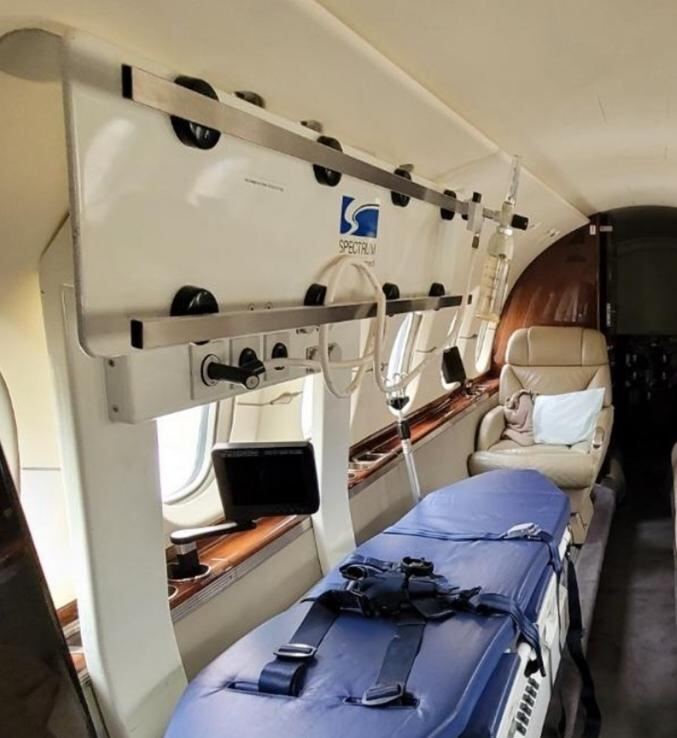
ICU-configured air ambulance cabin, illustrating the difference between a dedicated repatriation jet and a commercial medical escort
    24/7 Operations Desk · Active Now

    Repatriation Options · Decision Guide

    Air Ambulance vs Medical Escort: Which Repatriation Option Fits the Patient

    Two very different products, priced very differently, with very different clinical envelopes. A clear side-by-side for families, corporates and assistance companies choosing between a dedicated ICU jet and a nurse or physician escort on a scheduled airline.

    Already have an RFQ prepared? Email charters@aviall.com.au

    2 options
    Compared honestly
    Bed-to-bed
    Both configured
    <2 hr
    Quote turnaround
    24/7
    Medical control

    Speaking to someone is usually the fastest way to start.

    Our medical transfer desk is staffed 24 hours. You do not need complete information to make the first call, the current location of the patient and where they need to go is enough to begin.

    Patient information is treated as sensitive. Medical detail and uploaded reports go only to the clinical and operations coordinators handling the case, are never placed in web addresses, and are never shared with advertising or analytics platforms.

    The two products in one paragraph each

    A dedicated air ambulance is a private jet configured as a flying ICU, stretcher, ventilator, monitoring, oxygen, infusion pumps, medications, flown by a two-pilot crew with a physician and flight nurse on board (or specialist teams for neonatal, paediatric, ECMO or bariatric cases). It flies directly point-to-point on the schedule the patient's condition requires.

    A commercial medical escort is a nurse or physician accompanying the patient on a scheduled airline flight, typically in business class or on a stretcher installation across a row of economy seats, depending on the airline and the patient's condition. The clinical team travels with the patient, but the aircraft is a normal passenger jet on a normal timetable, and the equipment carried is what the clinical team can walk on board.

    Cost, the honest side-by-side

    The dominant driver of the cost gap is the aircraft itself. A dedicated air ambulance is a chartered private jet, and its price reflects that. A commercial medical escort re-uses a scheduled seat or a small block of seats, plus the clinical team's travel, so the marginal aircraft cost is far lower.

    Indicative ranges (orientation only, not a quote):

    • Dedicated air ambulance, short regional (under 1,000 nm): AUD $25,000-$80,000
    • Dedicated air ambulance, medium international (1,000-4,000 nm): AUD $80,000-$250,000
    • Dedicated air ambulance, long-haul intercontinental (4,000+ nm): AUD $200,000-$600,000
    • Commercial medical escort, regional business-class: typically AUD $8,000-$25,000 all-in
    • Commercial medical escort, long-haul with stretcher install: typically AUD $30,000-$90,000 all-in

    Clinical capability, where each option stops

    A dedicated air ambulance carries an ICU-grade equipment envelope: invasive ventilation, multi-parameter monitoring, infusion pumps, defibrillator, full drug formulary, and specialist additions (ECMO, neonatal incubator, bariatric stretcher, IABP) configured to the mission. The clinical team is on the aircraft the entire flight with no interruption.

    A commercial medical escort operates within what the airline will accept on board and what the escort team can carry through security and cabin restrictions. That typically means no invasive ventilation, no continuous vasoactive infusions, no unstable airway, no infectious isolation, and no patient who cannot tolerate the cabin altitude and duration of a scheduled airline flight. It also means the patient's care depends on being able to divert to a medical facility on the ground rather than continuing care in flight, if their condition deteriorates.

    The rule of thumb: if the patient is stable enough to fly on a scheduled airline with clinical support, a medical escort is often the right call. If the patient is unstable, ventilated, on infusions, isolation, specialist paediatric or neonatal, or requires uninterrupted ICU-level intervention, a dedicated air ambulance is not optional. It is the only clinically acceptable product.

    Speed and flexibility of deployment

    Dedicated air ambulance activation is faster and more flexible on the departure end. Aviall can typically position an aircraft within hours anywhere across Asia-Pacific, fly point-to-point, and land at the airfield closest to the receiving hospital. There is no airline schedule constraint and no connection risk.

    Commercial medical escort deployment is constrained by scheduled airline capacity, seat availability in the right class, stretcher installation slots (which many airlines require days of notice for), medical clearance from the airline's medical department, and the airline's own routing. On busy routes and at short notice, seats or stretcher slots may not be available for several days.

    For time-critical repatriation the dedicated air ambulance almost always wins on speed. For planned repatriation where the patient is stable and can wait for the right schedule, medical escort is often just as fast in practice.

    Suitability by patient condition, a practical guide

    A short field guide, based on Aviall's routine repatriation activity across Asia-Pacific:

    • Post-cardiac event, stable, off inotropes, ambulatory: medical escort often appropriate
    • Post-orthopaedic (fracture, joint, spinal) requiring stretcher, stable: medical escort with stretcher usually appropriate
    • Post-stroke, stable, no airway concerns: medical escort often appropriate
    • Ventilated / intubated / tracheostomy on vent: dedicated air ambulance mandatory
    • Vasoactive infusions ongoing: dedicated air ambulance mandatory
    • Neonatal (any premature or critical newborn): dedicated air ambulance with neonatal team mandatory
    • Paediatric ICU-level: dedicated air ambulance mandatory
    • Infectious isolation required: dedicated air ambulance mandatory
    • Bariatric patient beyond airline stretcher capacity: dedicated air ambulance mandatory
    • Psychiatric with escort risk profile: assessed case-by-case, both options possible
    • End-of-life repatriation, stable: medical escort often appropriate; dedicated air ambulance where dignity, family or clinical factors require it

    Insurance, assistance and paperwork

    Most international travel and corporate policies cover both products, coordinated through an assistance company. Assistance case managers routinely triage between air ambulance and medical escort on the basis of a treating-physician report, the clinical envelope drives the decision more than the ticket price. Aviall liaises directly with assistance companies and insurers on both products, including the treating-physician report, the receiving-hospital acceptance, the fit-to-fly clearance and the payment paperwork.

    Where there is no assistance cover, families sometimes prefer to under-spec because of price sensitivity. Aviall's medical control desk will always recommend the clinically appropriate product regardless of budget, under-speccing repatriation is the most common preventable cause of in-flight deterioration and diversion in this industry, and we won't participate in it.

    When both options are clinically viable, how we recommend

    For patients who fall in the overlap zone (stable, non-ICU, non-infectious), Aviall's medical control desk provides a written comparison: aircraft type or airline / class, clinical team, activation window, all-in cost, and clinical risk. The assistance company, insurer or family then makes the commercial call on a like-for-like basis. There is no upsell to the dedicated air ambulance where a medical escort will do the job clinically. We quote whichever product fits the mission.

    Aviall coordinates both

    Dedicated air ambulance

    ICU-configured private jets across Asia-Pacific and intercontinental, with physician and flight nurse baseline and specialist team add-ons.

    Commercial medical escort

    Nurse or physician escort on scheduled airline, business class or stretcher installation, airline medical clearance handled.

    Bed-to-bed on both products

    Ground ambulance links, receiving hospital coordination, customs, immigration and documentation on both product paths.

    Honest triage

    Medical control desk recommends the clinically appropriate product, no upsell where a medical escort will do the job.

    Written comparison

    Where both products are viable we quote both side-by-side so the assistance company, insurer or family can decide on like-for-like terms.

    Assistance & insurance liaison

    Direct coordination with assistance case managers and insurers on both products, including all clinical paperwork.

    Medical transfer & repatriation desk

    Request a medical transfer

    You do not need a complete clinical picture to contact us. Tell us where the patient is and where they need to go, and a coordinator will start assessing options, aircraft, clinical configuration, crewing, clearances and ground ambulance, while the rest of the information is still being gathered.

    Enough to start

    • Where the patient is now

      City or country, and the facility type if you know it

    • Where they need to go

      City, country, or receiving hospital if already arranged

    • Rough timing

      Today, within 24 hours, or later this week

    • How they are travelling

      Seated, wheelchair, stretcher, or intensive care, an estimate is fine

    Helpful, but can follow

    • A medical report, discharge summary or fit-to-fly assessment, uploaded securely
    • Treating team or transfer-desk contact, so our clinical coordinator can speak with them directly
    • Insurer, assistance company or funding arrangement, if one applies
    • Receiving hospital acceptance, where that is still being organised

    Clinical acceptance and aircraft availability are confirmed after review by the clinical team and the receiving facility. Contacting us does not by itself confirm a flight, a crew or acceptance of the patient.

    Or email medical reports and case detail to charters@aviall.com.au

    Privacy: patient details and uploaded reports are handled as sensitive information, stored in restricted storage, and passed only to the coordinators and clinicians working the case. They are never written into web addresses, advertising platforms or analytics events.

    Urgent charter? Our ops desk is staffed 24/7.

    Aircraft options within the hour and a written quote with an indicative wheels-up window.

    Mission examples · Illustrative

    What this looks like in operation

    Representative mission profiles drawn from recurring work. Identifying details, operators, hospitals, routes, aircraft tail numbers, are intentionally omitted.

    International · Repatriation

    Long-range stretcher repatriation across the Pacific

    A complex case with ventilator and infusion support required movement from a regional Pacific facility back to a domestic tertiary centre. Aviall configured a long-range jet with a critical-care medical fit-out, coordinated bed-to-bed handover with both treating teams, and managed customs and immigration at each stop.

    Outcome

    Bed-to-bed transfer completed without clinical deterioration en route.

    Neonatal · Critical

    Neonatal transfer to a tertiary paediatric centre

    A neonate requiring escalated care had to be moved from a regional hospital to a metropolitan paediatric tertiary centre. Aviall coordinated an aeromedical aircraft and a specialist retrieval team, with isolette-compatible loading and parent transit on the same airframe.

    Outcome

    Patient delivered to receiving NICU within the clinical window agreed by both teams.

    Remote · Mining medevac

    Trauma extraction from a remote mine site

    An incident at a remote mine site required immediate movement of a trauma patient to a metropolitan trauma centre. Aviall launched on the standing medevac protocol, with a clinical team mobilised in parallel and the receiving trauma team pre-briefed before take-off.

    Outcome

    Patient on the operating table at the receiving centre well inside the planned window.

    Group medical · Disaster

    Multi-patient evacuation after a regional event

    Following a regional medical surge, an insurer required several patients moved out of an under-resourced facility on a single mission. Aviall configured a larger airframe with multiple stretcher positions, a senior medical lead and ground ambulance staging at both ends.

    Outcome

    All patients transferred safely on a single rotation; receiving facility briefed before arrival.

    Commercial repatriation

    Stretcher case on scheduled wide-body

    Where the clinical picture allowed, Aviall arranged a stretcher booking on a commercial wide-body service with a medical escort, including airline approvals, MEDIF clearance, oxygen calculations and ground handover.

    Outcome

    Cost-effective repatriation completed without the need for a dedicated airframe.

    Organ transport

    Time-critical transplant logistics

    A transplant programme required time-critical movement of a viable organ between two metropolitan centres with a hard ischaemic window. Aviall held an aircraft on standby, coordinated tarmac transfers at both ends and ran a flight-following bridge with the surgical team.

    Outcome

    Organ delivered inside clinical viability window; recipient surgery proceeded on schedule.

    Air ambulance vs medical escort, quick reference

    Aircraft
    Air ambulance: private jet ICU · Medical escort: scheduled airline seat/stretcher
    Clinical envelope
    Air ambulance: full ICU incl. vent, infusions, isolation · Escort: stable, non-ICU only
    Indicative cost
    Air ambulance: $25k-$600k+ · Medical escort: $8k-$90k typical
    Activation
    Air ambulance: hours · Medical escort: constrained by airline schedule and stretcher slot
    Routing
    Air ambulance: point-to-point, closest airfield · Escort: airline network only
    Assistance / insurance
    Both products routinely covered, triaged by treating-physician report

    FAQ

    Frequently Asked Questions

    An air ambulance is a private jet configured as a flying ICU, flown point-to-point with a physician and flight nurse and full ICU equipment. A medical escort is a nurse or physician travelling with the patient on a scheduled airline flight, in business class or on an airline stretcher. The clinical envelope, cost and deployment speed are very different.

    Why operators, brokers and end clients keep calling back

    Credibility built on operational discipline, not marketing

    "Single point of clinical accountability from the call to bed-to-bed handover. Our retrieval team had everything they needed before wheels-up."

    , Aeromedical retrieval lead · Tertiary hospital network

    "The case management discipline matched our internal standards. That is unusual in the assistance market."

    , Operations director · International medical assistance company

    "Aircraft selection was driven by the patient's clinical picture, not by what was on the apron. That is the right way around."

    , Critical-care physician · Repatriation case

    Not sure whether you need an air ambulance or a medical escort?

    Send the treating-physician report and destination. Aviall's medical control desk returns a written comparison, both products, both costs, clinical recommendation. In under two hours.

    Have a live requirement?

    Tell us where the patient is and where they need to go, that is enough to start. Our medical desk is staffed 24 hours. Attach an existing RFQ, packing list or photos straight from your phone, partial detail is enough to start.

    Requirement

    Medevac / Air Ambulance

    Only the first four fields are needed to start. Anything clinical can follow by phone, email or upload. Patient information is handled as sensitive and is never shared with advertising or analytics platforms.

    AttachmentsMedical reports, fit-to-fly assessments or insurer authorisations, uploaded to restricted storage. Files up to 20MB each, 10 max. PDF, Word, Excel, CSV, images or email files.

    Final medical and operational acceptance is subject to clinical review and aircraft/operator availability. Submitting this form does not confirm an aircraft or a medical crew.

    Goes straight to our charter desk at Charters@Aviall.com.au. Submitting an RFQ does not confirm an aircraft.