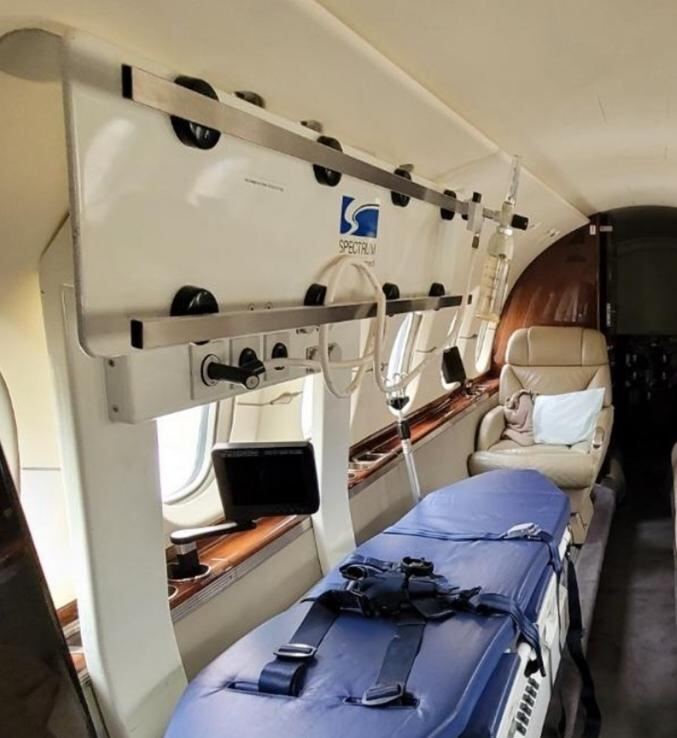
Medical repatriation is the transfer of a patient from a hospital in one country to a hospital or home in another. Three processes run in parallel: a clinical decision about whether and how the patient can safely fly, a logistics operation to move them bed to bed, and an approval process with whoever is paying. Delays are almost always caused by the third.
Step 1, Clinical assessment and fit-to-fly
It begins with a medical report from the treating hospital: diagnosis, current status, treatment, medications, mobility, oxygen requirement, invasive lines or ventilation, infection status and the treating team's view on transportability. A flight physician reviews this and determines whether the patient can fly, in what configuration, with what escort, and whether they should wait for further stabilisation. Cabin altitude affects oxygenation and trapped gas, so conditions such as recent surgery, pneumothorax, severe anaemia or unstable cardiac and neurological presentations are assessed carefully.
Step 2, Choosing the transport mode
There is a spectrum, and matching it to the clinical picture is where most of the cost is decided.
**Commercial seat with a medical escort**, for stable patients able to sit, accompanied by a nurse or doctor. See medical escort flights.
**Commercial stretcher**, a stretcher installed in a screened section of a scheduled aircraft, with a clinical escort. Cost-effective but limited to certain airlines and routes, and it needs lead time. See stretcher flights.
**Dedicated air ambulance**, a configured aircraft with a full clinical team, for unstable, ventilated or ICU-level patients, or where timing cannot fit an airline schedule.
The most expensive option is not automatically the safest, and the cheapest is not automatically adequate. The flight physician's assessment decides.
Step 3, Approvals and who pays
Funding usually comes from travel insurance, a corporate or expatriate policy, a government scheme, or the family directly. Where an insurer or assistance company is involved, they authorise the mode and the cost against the medical evidence. In genuine emergencies, verbal authorisation to begin planning is often given while paperwork completes in parallel. If there is no insurance cover, the family funds the movement and should understand the mode options and their cost differences early.
Step 4, Bed-to-bed logistics
A repatriation is not a flight; it is a chain. Ground ambulance from the sending hospital, airport access and clearances, the flight itself with any technical stops, immigration and customs at the destination for an unscheduled medical arrival, ground ambulance at the far end, and a confirmed receiving facility that has formally accepted the patient. A receiving bed must be confirmed before departure, an aircraft cannot arrive with a patient and no accepting hospital.
Step 5, Clinical handover and the flight
Handover is taken from the sending team, transfer thresholds are agreed, medications and equipment are prepared for the full duration including contingency, and the patient is transferred to the aircraft stretcher. In cruise the medical team manages the patient against those agreed thresholds. On arrival, handover is given to the receiving team and the clinical record is transferred.
What to prepare
The current medical report and contact details for the treating doctor, passport and visa details for patient and escorts, insurance policy number and case reference, the proposed receiving hospital or the request that we identify one, mobility and oxygen requirements, and next-of-kin contacts. Related reading: how much a medevac flight costs, international medical repatriation and repatriation cost guide.
Timeframes
Emergency repatriations move as fast as clinical stability, permits and the receiving bed allow. Planned repatriations typically take a few days from first call to movement, with the medical report, insurer authorisation and the receiving bed usually the pacing items rather than the aircraft.