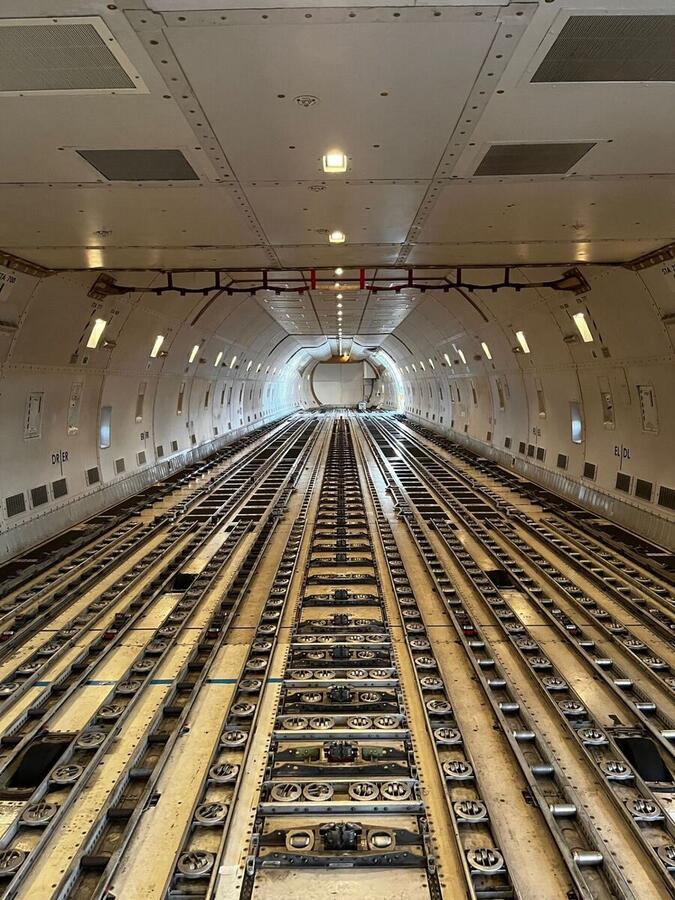
Interior cargo hold of a widebody freighter loaded with palletised equipment
    24/7 Operations Desk · Active Now

    Programme capacity

    Large-Scale Technology Air Freight into Australia

    A full deployment is not one shipment. It is a sequence of rotations, and the ones planned early cost a fraction of the ones bought in panic.

    Already have an RFQ prepared? Email charters@aviall.com.au

    Multi-rotation
    Planned as a programme
    Mixed fleet
    Aircraft matched per tranche
    Milestone-led
    Scheduled to install sequence
    24/7
    Charter desk

    Why large deployments fail on logistics rather than hardware

    On a large Australian data centre or AI build, the hardware is rarely the thing that slips first. What slips is the alignment between manufacturing release, air capacity, clearance and the site's ability to receive equipment in the order the installation team needs it. Each of those is manageable individually; the difficulty is that they are usually managed by different parties with different visibility.

    The most expensive pattern we see is repeated spot buying. A programme moves tranche by tranche, each one becoming urgent before capacity is secured, each one priced under time pressure in a market where technology demand spikes are correlated. The same volume planned as a rotation series is normally cheaper and far more predictable.

    The second most expensive pattern is arriving early in the wrong order. Equipment that lands before the site can receive it becomes a storage, handling and double-movement cost, and on constrained sites it can physically block the sequence for equipment that is genuinely needed.

    How to size tranches before you know everything

    Programme planning does not require certainty. Approximate figures are enough to model the aircraft requirement usefully: expected total equipment volume, an approximate split by commodity type, the origins in play, and a milestone calendar with the dates that genuinely cannot move.

    From that we can model how many rotations of which aircraft types the programme implies, where two tranches should be combined and where one should be split, and which movements are structurally fragile, typically those depending on a single origin release inside a narrow window.

    Tranche sizing is almost always volume-led rather than weight-led for compute and racks, and the reverse for power plant. A realistic programme model reflects both, because mixing a dense switchgear tranche and a volumetric rack tranche into the same rotation is frequently how usable capacity gets wasted.

    • Total expected volume and CBM, even as a range
    • Approximate split: racks and compute, networking, cooling, power
    • Origins by commodity, Taiwan, China, Southeast Asia, USA, Europe
    • Milestone calendar: energisation, commissioning, handover, go-live
    • Site receiving constraints: access hours, hardstand, lifting, install order

    Aircraft mix across a deployment

    Very few programmes are best served by a single aircraft type. Early infrastructure tranches lean toward nose-loading or ramp-loading types for tall and oversized plant. The main compute phase is volume-dominated and usually maps to 777F or 747F full-deck rotations. Fit-out, networking and spares phases are frequently better served by smaller widebodies or narrowbodies at higher frequency.

    Aviall is not an aircraft operator. We source across a wide operator base, which is what makes a mixed-fleet programme practical: each rotation is shortlisted on genuine availability and suitability for that tranche rather than on what one operator happens to fly.

    • 747F, maximum volume plus nose loading for oversized infrastructure
    • 777F, the workhorse for full-deck rack and compute rotations
    • A330-200F / 767F, right-sized tranches and higher-frequency phases
    • AN-124, genuinely oversized or very heavy single pieces
    • Narrowbody freighters, spares, single units and urgent gap-fills

    Building an escalation path before you need it

    On every large deployment, some movements become urgent. The difference between programmes that absorb that and programmes that lose weeks is whether an escalation path existed beforehand, a known desk contact, an understood approval route, and dangerous goods and packaging detail already on file so a quote does not restart from zero.

    We hold the programme's recurring detail: commodity profiles, typical crate dimensions, lithium content, packaging standards and site receiving constraints. When an urgent rotation is needed, the enquiry becomes a date and a tranche rather than a fresh specification exercise, which is usually where the hours are actually saved.

    Aviall's role on a technology programme

    Aviall Group arranges dedicated aircraft charter capacity. We are not the freight forwarder, the customs broker, the data centre builder, the hardware manufacturer or the aircraft operator.

    On large programmes we typically sit alongside the forwarder and the project logistics team, who hold the ground scope, customs and site interface. We plan and provide the air capacity, supply the aircraft, volumetric and dangerous goods detail needed for internal approval, and coordinate each rotation around the plan they control.

    What programme support covers

    Rotation modelling

    Aircraft count and types modelled from approximate volumes and milestones.

    Mixed-fleet sourcing

    Each tranche shortlisted on suitability, not on one operator's fleet.

    Tranche optimisation

    Advice on combining or splitting loads so deck space is not wasted.

    Fragility flagging

    Movements dependent on a single narrow release window identified early.

    Standing DG profile

    Lithium and refrigerant detail held on file so urgent quotes move fast.

    Site sequencing

    Arrivals ordered to what the installation team can receive.

    Pre-agreed escalation

    A known route for the rotations that inevitably become urgent.

    Forwarder-friendly engagement

    Air capacity planning that sits inside your existing logistics scope.

    Data centre & AI infrastructure

    Have a live technology shipment?

    Send us the requirement.

    Our charter desk works to the same inputs a forwarder or project logistics team already holds. Send the details below and we return suitable aircraft options, payload and volume feasibility, and an indicative wheels-up window. Estimates are enough to start while crating and release paperwork are finalised.

    Already have an RFQ?

    Email charters@aviall.com.au

    Send us

    • 01OriginAirport, factory, integrator or staging warehouse
    • 02DestinationArrival airport and final site address
    • 03PayloadGross weight, piece count, crated or uncrated
    • 04Dimensions / CBMPer crate: L x W x H, plus total volume
    • 05Ready dateWhen the equipment is crated and released
    • 06CommodityRacks, GPU nodes, UPS, switchgear, cooling plant
    • 07Packing listUpload with the RFQ, the fastest route to an answer

    Packing lists, drawings and crate schedules can be uploaded directly with the RFQ form, up to 10 files.

    Urgent charter? Our ops desk is staffed 24/7.

    Aircraft options within the hour and a written quote with an indicative wheels-up window.

    Programme planning, quick reference

    Useful inputs
    Approximate total CBM, commodity split, origins, milestone calendar
    Typical structure
    A rotation series aligned to manufacturing releases and site milestones
    Sizing driver
    Volume for compute and racks, weight and dimensions for power plant
    Common aircraft mix
    747F, 777F, A330-200F, 767F, narrowbody, AN-124 where oversized
    Main risk
    Correlated demand spikes making spot capacity scarce and expensive
    Response time
    Aircraft options usually within the hour; programme models within days

    FAQ

    Frequently Asked Questions

    As soon as an approximate equipment volume and a milestone calendar exist, well before purchase orders are finalised. Early conversations cost nothing and change the outcome most, because that is when tranche sizing, gateway choice and rotation timing are still adjustable.

    Planning air capacity for a large Australian technology deployment?

    Send the approximate volumes, origins and milestone calendar, or a single live tranche with origin, destination, payload, dimensions, ready date and packing list. Our desk returns aircraft options and feasibility.

    Have a live requirement?

    Send us origin, destination, payload and ready date. We return aircraft options. Attach an existing RFQ, packing list or photos straight from your phone, partial detail is enough to start.

    Requirement

    Cargo

    AttachmentsPacking list, cargo dimensions, manifest, RFQ document, images or other supporting documentation. Files up to 20MB each, 10 max. PDF, Word, Excel, CSV, images or email files.

    Goes straight to our charter desk at Charters@Aviall.com.au. Submitting an RFQ does not confirm an aircraft.