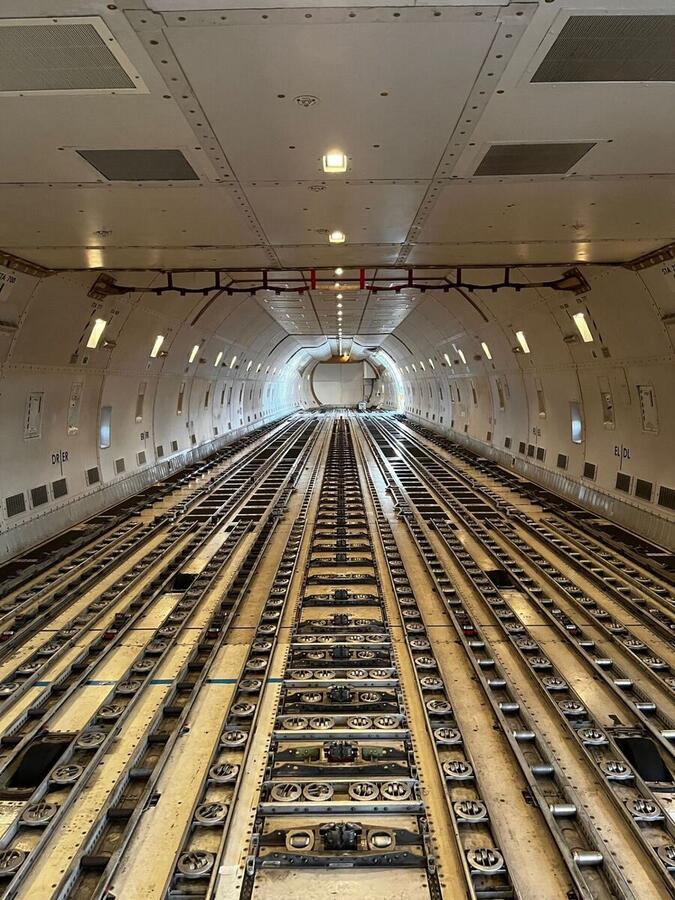
Crated technology cargo secured inside a widebody freighter cargo hold
    24/7 Operations Desk · Active Now

    Educational Resource · Data Centre Inbound

    How Are Server Racks Shipped to Australia?

    Ocean, consolidated airfreight or a dedicated freighter, the honest comparison, and how the decision is actually made against a commissioning date.

    Already have an RFQ prepared? Email charters@aviall.com.au

    3 modes
    Compared honestly
    Volume first
    Not weight first
    ISPM 15
    Biosecurity aware
    24/7
    Charter desk

    The three realistic routes into Australia

    Almost every server rack that lands in an Australian data centre arrives by one of three routes: containerised ocean freight, consolidated airfreight on scheduled passenger or freighter services, or a dedicated cargo aircraft chartered for that consignment. The right answer depends far less on the hardware than on the date it has to be installed and how much of the tranche has to arrive together.

    Ocean freight remains the default for base-build equipment ordered well ahead of a fit-out programme. Transit from Northeast Asia to the east coast typically runs several weeks door to door once inland legs, port dwell and clearance are included, and schedule reliability rather than sailing time is usually what breaks a plan. It is the cheapest route by a wide margin and entirely appropriate when the buffer exists.

    Consolidated airfreight is the middle option and handles a large share of technology inbound volume. It is fast, frequent and priced per kilogram, but capacity is sold in units that suit general freight, not tall crated cabinets, so the practical limits are height, pallet build and how many pieces a carrier will accept on a single flight.

    Charter is what remains when the tranche does not fit those constraints: too many crates to move at once, a crate too tall for the intended aircraft's usable height, a delivery window shorter than scheduled uplift and connections can deliver, or a requirement that the whole consignment stays on one aircraft under one custody chain.

    Can server racks be transported by air at all?

    Yes, routinely. Racks and populated cabinets are carried by air every day, and the practical questions are dimensional and regulatory rather than whether it is possible. A crated rack is a large, relatively light box: it consumes volume and pallet positions long before it approaches an aircraft's weight limit, which is why a full tranche of racks often fills a widebody deck at well under the freighter's structural payload.

    Height is the constraint that decides the aircraft. Crated cabinets frequently exceed the usable height of narrowbody positions and of the outer contoured positions on a widebody deck, so the achievable piece count on a given aircraft is lower than a simple floor-area calculation suggests. Where a single unit is unusually tall or long, a nose-loading 747F may be the only workable option even though the weight is trivial.

    The second regulatory question is battery content. Populated racks and their associated backup modules often contain lithium cells, which places part or all of the consignment under IATA dangerous goods provisions. That does not prevent air transport, but it does change which operators can accept the load and how it must be packed and declared.

    • Crate external dimensions and gross weight per piece, the single most useful data point for aircraft selection
    • Whether the manufacturer permits lay-down transport or requires upright orientation throughout
    • Lithium content by UN number, watt-hour rating and whether cells are installed in equipment or packed separately
    • Centre of gravity and any lifting, forklift or tilt restrictions marked on the crate
    • Whether the tranche must arrive complete or can be split across rotations

    Crating, orientation and what handlers see

    A rack's transport risk is largely determined before it leaves the integration facility. Racks shipped upright on shock-isolating bases, with clear orientation and tilt markings and an accurate centre-of-gravity indication, survive multiple handling events well. Racks packed for a single gentle road move and then routed through several airport handling agents do not.

    Populated versus stripped is a real decision with costs on both sides. Shipping populated saves site labour and shortens commissioning, but concentrates value, increases weight and brings more dangerous goods into scope. Stripping reduces transport exposure at the cost of reinstallation and retesting at site. Either is workable; what matters operationally is that the packing list reflects the decision accurately, because the load plan, DG paperwork and insurance all derive from it.

    Timber packaging bound for Australia must be treated and marked to ISPM 15 and free of bark, soil and contamination. Non-compliant packaging can be held, treated or destroyed at the importer's cost after arrival, which is an avoidable way to lose the days that charter was bought to save.

    Which aircraft carry rack tranches into Australia

    Aircraft selection follows the piece list, not the total weight. The questions are how many crates of that height fit, whether the largest piece passes the door aperture, and whether the airports at both ends can accept and turn the type.

    Aviall is not an aircraft operator. We source across a wide operator base and shortlist what is genuinely available for your dates, which is why we return options rather than one aircraft.

    • Boeing 747-8F and 747-400F, the highest-volume commercial freighters, with nose loading for long or tall single pieces
    • Boeing 777F, the common choice for full-deck rack and compute tranches on Asia–Australia sectors
    • Airbus A330-200F, well matched where a 777F is more aircraft than the tranche needs
    • Boeing 767F, efficient in the 30 to 45 tonne band and for programmes running frequent smaller rotations
    • 737-800F and A321F, single critical units and urgent partial loads
    • Outsize and ramp-loading types, where a module exceeds commercial freighter door and floor limits

    Clearance, gateway choice and the leg to site

    Sydney handles the largest share of technology inbound volume but operates under a night curfew that shapes arrival timing. Melbourne, Brisbane and Perth operate without a curfew, which can be decisive when a tranche must clear and reach site overnight ahead of an installation window. Choosing the gateway around the site and the installation sequence, rather than defaulting to the nearest large airport, frequently saves more time than a faster flight would.

    The final leg is the part most often underestimated. Data centre sites sit in industrial or peri-urban areas with restricted access hours, limited hardstand, specific lifting requirements and an installation order that only accepts equipment in sequence. We plan the domestic leg against the site's real receiving capability, and against the order the installation team needs, rather than against the fastest route out of the airport.

    Where Aviall fits, and where it does not

    Aviall Group arranges dedicated aircraft charter capacity. We are not the freight forwarder, the customs broker, the hardware manufacturer, the data centre builder or the aircraft operator. On most technology programmes those roles are already filled, and the gap is credible, fast access to the right aircraft with a load plan that survives contact with reality.

    That means we are comfortable being engaged purely for the air movement while your forwarder retains origin pickup, export clearance, import clearance and delivery. It also means we will tell you when scheduled airfreight or ocean is the better commercial answer for your shipment, a charter recommended against the evidence is not a relationship worth having.

    What we can tell you within the hour

    Volume or weight limited

    Whether your tranche fills the aircraft by cubic capacity or by payload, from the crate list.

    Real pallet position count

    How many crates of your height actually fit each candidate type, not a floor-area estimate.

    Door aperture feasibility

    Whether the largest piece loads through a side door or needs a nose-loading aircraft.

    Aircraft options and availability

    Shortlisted from a wide operator base against your dates and gateways.

    DG and lithium acceptance

    Which operators can accept the battery content as declared and packed.

    Gateway and curfew planning

    Arrival timing shaped around curfews, clearance and the installation window.

    Site delivery sequencing

    The onward leg planned against site access hours, lifting capability and install order.

    Honest mode comparison

    A straight answer on whether charter, scheduled airfreight or ocean serves you best.

    Data centre & AI infrastructure

    Have a live technology shipment?

    Send us the requirement.

    Our charter desk works to the same inputs a forwarder or project logistics team already holds. Send the details below and we return suitable aircraft options, payload and volume feasibility, and an indicative wheels-up window. Estimates are enough to start while crating and release paperwork are finalised.

    Already have an RFQ?

    Email charters@aviall.com.au

    Send us

    • 01OriginAirport, factory, integrator or staging warehouse
    • 02DestinationArrival airport and final site address
    • 03PayloadGross weight, piece count, crated or uncrated
    • 04Dimensions / CBMPer crate: L x W x H, plus total volume
    • 05Ready dateWhen the equipment is crated and released
    • 06CommodityRacks, GPU nodes, UPS, switchgear, cooling plant
    • 07Packing listUpload with the RFQ, the fastest route to an answer

    Packing lists, drawings and crate schedules can be uploaded directly with the RFQ form, up to 10 files.

    Urgent charter? Our ops desk is staffed 24/7.

    Aircraft options within the hour and a written quote with an indicative wheels-up window.

    Server racks to Australia, quick reference

    Ocean freight
    Cheapest, several weeks door to door, base-build equipment
    Consolidated airfreight
    Fast and frequent, limited by crate height and piece count
    Dedicated charter
    Whole tranche, one custody chain, fixed arrival window
    Usual binding constraint
    Crate height and volume before gross weight
    Packaging
    ISPM 15 treated timber, upright orientation where specified
    Gateways
    SYD, MEL, BNE, PER, CBR, ADL, DRW
    Response time
    Aircraft options usually within the hour

    FAQ

    Frequently Asked Questions

    Ocean freight from Northeast Asia is typically several weeks door to door once inland legs, port dwell and clearance are counted. Consolidated airfreight generally lands in days but depends on capacity and connections. A dedicated charter can usually depart within 12 to 48 hours of release, with flight time from Asia to the east coast measured in hours, the schedule risk moves to documentation and export release rather than transport.

    Moving racks against a commissioning date?

    Send origin, destination, payload, dimensions or CBM, ready date, commodity and packing list. We will model aircraft fit and return options with an indicative wheels-up window.

    Have a live requirement?

    Send us origin, destination, payload and ready date. We return aircraft options. Attach an existing RFQ, packing list or photos straight from your phone, partial detail is enough to start.

    Requirement

    Cargo

    AttachmentsPacking list, cargo dimensions, manifest, RFQ document, images or other supporting documentation. Files up to 20MB each, 10 max. PDF, Word, Excel, CSV, images or email files.

    Goes straight to our charter desk at Charters@Aviall.com.au. Submitting an RFQ does not confirm an aircraft.