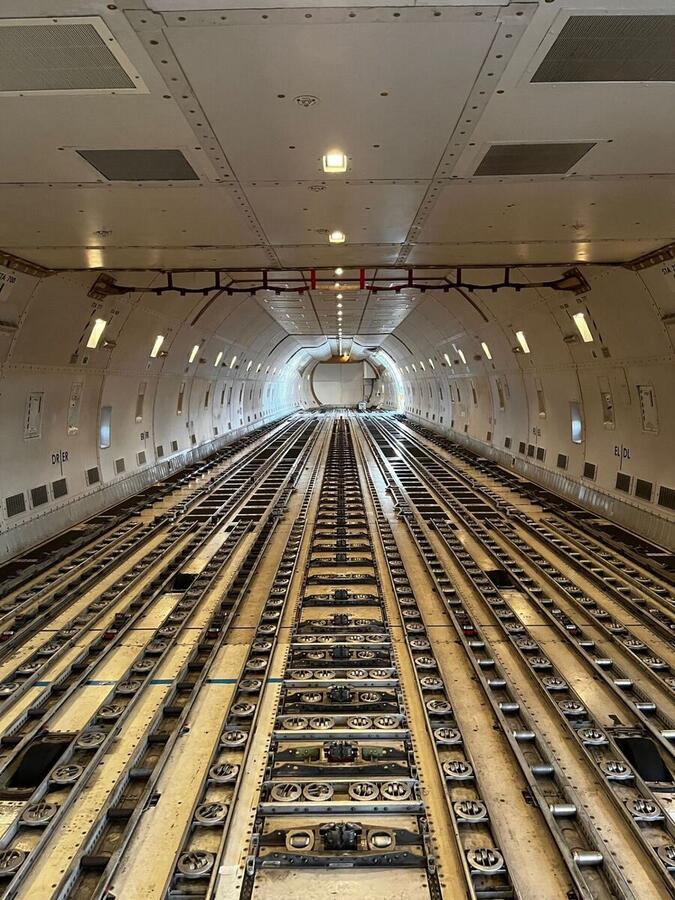
Crated technology equipment secured on pallets inside a freighter cargo hold
    24/7 Operations Desk · Active Now

    Educational Resource · Racks & Cabinets

    Air Freight Considerations for Server Racks

    Racks are the cargo that most often surprises a freight plan: light for their size, tall, orientation-sensitive, and expensive to re-crate at the airport.

    Already have an RFQ prepared? Email charters@aviall.com.au

    Volume first
    Not weight
    Height
    Most common limit
    Upright
    Usual orientation
    24/7
    Charter desk

    Racks are volumetric cargo, and that changes everything

    A crated server rack typically weighs a few hundred kilograms populated, but occupies close to two cubic metres once protective crating is added. The practical result is that a tranche of racks fills an aircraft's pallet positions and cubic capacity long before it approaches the structural payload limit. Quoting or planning that shipment on weight alone produces a number that has no relationship to what the movement actually costs.

    The useful metric is pallet positions consumed and total CBM, not kilograms. Once we know crate dimensions and quantity, we can say how many positions the tranche needs on each candidate aircraft, and whether the shipment is better served by one larger freighter or two rotations of a smaller type.

    Height is the constraint that changes the aircraft

    Standard rack heights, once crated and mounted on a base or shock isolator, frequently exceed the usable height profile of narrowbody freighter positions and of the outer contour positions on widebody main decks. A rack that fits comfortably in a centreline position may not fit at the edge of the same deck, which affects how many units the aircraft can actually take.

    This is why crate height including the base and any protective cap should be stated at enquiry rather than the bare equipment height. Where a rack is unusually tall, nose-loading types become relevant, and in some cases the decision is between shipping racks upright at lower density or shipping them laid down, a call that belongs to the manufacturer's handling instructions, not to the freight plan.

    Orientation, shock and vibration

    Most rack and cabinet manufacturers specify an upright orientation and a maximum tilt angle during handling, and populated racks carry additional sensitivity in drives, connectors, rail-mounted equipment and cable management. Air transport introduces vibration during taxi, take-off and landing that differs in character from road or sea movement.

    Practical protection is a combination of shock-isolating bases, correct internal blocking so equipment cannot move within the cabinet, and clear handling instruction communicated to every ground handler along the route rather than relying on crate markings. Where drives or memory are removed for transport and hand-carried separately, that decision should be made with the OEM or integrator, and reflected in both the packing list and the reinstallation plan at site.

    • State the manufacturer's maximum tilt angle and any no-lay-down instruction up front
    • Specify whether racks ship populated, partially populated or empty. It changes both weight and handling
    • Use shock-isolating bases rated to the actual crate weight, not to a generic figure
    • Consider shock and tilt indicators where a warranty or acceptance test depends on demonstrable handling
    • Confirm that ground handling equipment at both ends can lift the crate without slinging it in a prohibited way

    Crating for air rather than for sea

    Sea crating is often built for stacking and long humidity exposure, and it is frequently heavier and larger than air transport requires. Air-optimised crating aims for the smallest safe external envelope, because every additional centimetre of height or width can cost a pallet position or force a change of aircraft.

    Timber packaging also carries a biosecurity dimension into Australia. ISPM 15 treatment and marking, and the absence of bark, soil and pest contamination, are inspected on arrival. A biosecurity hold on a rack tranche can easily exceed the time the charter was bought to save, so treatment certification should be confirmed before departure rather than at the border.

    When charter is the right answer for racks

    Scheduled airfreight handles individual racks and small quantities well. Charter becomes the better option when the tranche is large enough that scheduled capacity would split it across several days or several carriers, when the racks must arrive together because installation is sequenced, when crate height exceeds what scheduled uplift will accept, or when a fixed commissioning or handover date makes a partial delivery worthless.

    The decision is generally commercial rather than technical. If the hall cannot be energised until the full tranche is on site, the cost comparison is between the charter premium and the value of the delay, not between charter and airfreight rates per kilogram.

    How we plan a rack movement

    Crate-level modelling

    Per-crate dimensions modelled into pallet positions and usable height on each candidate aircraft.

    Orientation compliance

    Tilt limits and upright requirements written into the loading plan and briefed to every handler.

    Crate envelope review

    Crating checked against door aperture and deck contour before capacity is committed.

    Biosecurity readiness

    ISPM 15 treatment, marking and cleanliness confirmed ahead of an Australian arrival.

    Sequenced arrival

    Delivery order aligned to the installation sequence rather than to freight convenience.

    Site access planning

    Onward leg matched to site receiving hours, lifting capability and dock constraints.

    Data centre & AI infrastructure

    Have a live technology shipment?

    Send us the requirement.

    Our charter desk works to the same inputs a forwarder or project logistics team already holds. Send the details below and we return suitable aircraft options, payload and volume feasibility, and an indicative wheels-up window. Estimates are enough to start while crating and release paperwork are finalised.

    Already have an RFQ?

    Email charters@aviall.com.au

    Send us

    • 01OriginAirport, factory, integrator or staging warehouse
    • 02DestinationArrival airport and final site address
    • 03PayloadGross weight, piece count, crated or uncrated
    • 04Dimensions / CBMPer crate: L x W x H, plus total volume
    • 05Ready dateWhen the equipment is crated and released
    • 06CommodityRacks, GPU nodes, UPS, switchgear, cooling plant
    • 07Packing listUpload with the RFQ, the fastest route to an answer

    Packing lists, drawings and crate schedules can be uploaded directly with the RFQ form, up to 10 files.

    Urgent charter? Our ops desk is staffed 24/7.

    Aircraft options within the hour and a written quote with an indicative wheels-up window.

    Mission examples · Illustrative

    What this looks like in operation

    Representative mission profiles drawn from recurring work. Identifying details, operators, hospitals, routes, aircraft tail numbers, are intentionally omitted.

    Heavy lift · Project cargo

    Outsize mining component into a remote regional strip

    An ASX-listed resources operator faced a stalled processing line waiting on a single oversized component too large for any scheduled freighter. Aviall sourced an outsize main-deck nose-loader, completed pavement and load-spread checks at the regional destination, and coordinated road movement permits at both ends.

    Outcome

    Component on site inside 72 hours of first call; production line restart same week.

    Rack air freight, quick reference

    Typical crated weight
    Varies widely with population; usually modest for the volume
    Typical crated volume
    Around 1.5 - 2.5 CBM per rack
    Binding constraint
    Height and pallet positions
    Usual orientation
    Upright, with a stated maximum tilt angle
    Packaging note
    Air-optimised crating, ISPM 15 treated timber
    Charter trigger
    Full tranche, sequenced install or fixed commissioning date

    FAQ

    Frequently Asked Questions

    It depends almost entirely on crate dimensions rather than weight. Widebody freighters carry a substantial number of rack positions, but the achievable figure changes with crate height, because outer deck positions have a lower usable height than centreline positions. Send crate dimensions and quantity and we will model the actual position count on each candidate aircraft.

    Moving racks against a commissioning date?

    Send crate dimensions, quantity, payload, origin, destination and ready date. We will model pallet positions, aircraft fit and an indicative wheels-up window.

    Have a live requirement?

    Send us origin, destination, payload and ready date. We return aircraft options. Attach an existing RFQ, packing list or photos straight from your phone, partial detail is enough to start.

    Requirement

    Cargo

    AttachmentsPacking list, cargo dimensions, manifest, RFQ document, images or other supporting documentation. Files up to 20MB each, 10 max. PDF, Word, Excel, CSV, images or email files.

    Goes straight to our charter desk at Charters@Aviall.com.au. Submitting an RFQ does not confirm an aircraft.