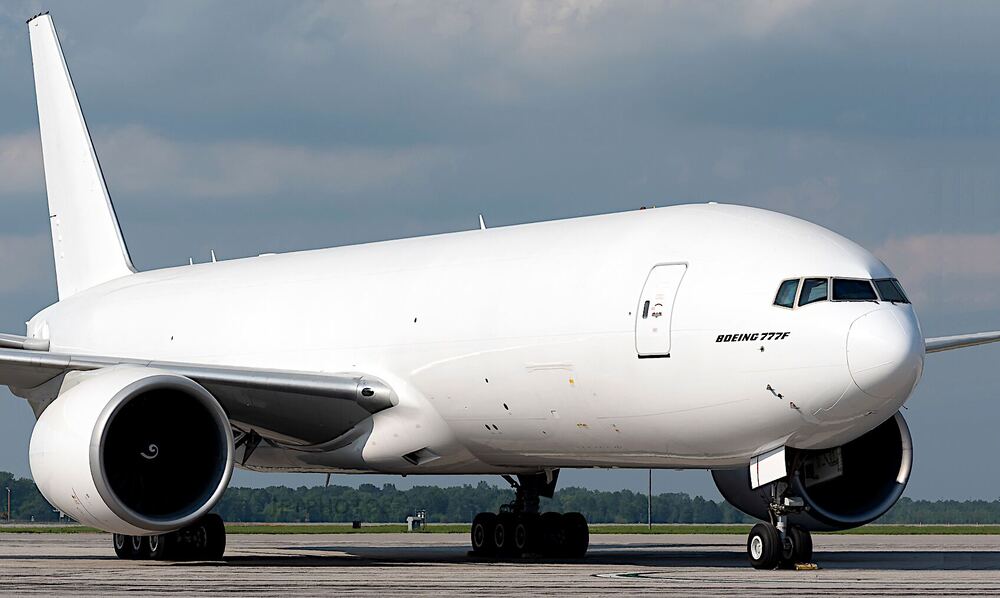
For most high-volume technology tranches the 777F is the commercially better aircraft, and the 747F is chosen when something about the cargo, height, length or total cubic volume, makes it necessary. That is the honest hierarchy: pick the 777F unless the load forces the 747F.
The reason is that technology cargo is volumetric rather than dense. A full deck of crated racks, GPU nodes, CDUs and packaged electronics fills cubic capacity and pallet positions well before either aircraft approaches its payload limit, so the comparison is decided by geometry and cost rather than tonnage.
Volume and pallet positions
The 747-8F offers the largest main-deck volume in widespread commercial service, roughly 694 m³ on the main deck with around 30 pallet positions, plus lower-hold capacity. The 777F carries approximately 27 main-deck pallet positions with a smaller total volume. In practice that means a 747F absorbs meaningfully more crated volume per rotation, which matters when a tranche is genuinely large and the site can install it.
Where a tranche fits comfortably inside a 777F deck, the extra 747F capacity is paid for and unused. Where a tranche is around one and a half 777F loads, the choice is between one 747F rotation and two 777F rotations, and the answer depends on rate, availability and whether the site would rather receive the equipment in two smaller deliveries.
Door height and nose loading, the real differentiator
The 747F main-deck side door offers roughly 3.1 m of height and the 777F approximately 3.05 m, which is close enough that a marginal crate is marginal on both. The decisive difference is the 747F's upward-hinging nose door, which allows long single pieces to be loaded along the deck centreline. The 777F has no nose door and loads exclusively through side doors.
For data centre cargo that matters in two specific cases. First, tall crated racks that cannot be laid down: many rack manufacturers permit transport only in the upright orientation, or require written approval to tilt, and where upright height exceeds usable position height the 747F's greater main-deck contour can be the only commercial option. Second, long items such as busway runs, containerised modules and certain cooling assemblies, which the nose door accepts and a side door does not.
If neither applies, the nose door is a capability you are paying for and will not use.
747F: main-deck side door around 3.4 m x 3.1 m, plus a nose door for long pieces
777F: main-deck door around 3.73 m x 3.05 m, wider aperture, no nose access
Crate height must be checked against usable height at the pallet position, not the door alone
Floor loading, not payload, binds for transformers, UPS banks and switchgear
Range, sector length and technical stops
Both types operate the long-haul lanes that feed Australian data centre projects. The 747-8F carries approximately 133 tonnes structural payload with a published range in the order of 4,340 nm at maximum payload; the 777F is a twin with strong long-haul performance at high payload and typically the better fuel economics per tonne carried.
On the corridors that matter, Taiwan, China, Japan, Korea and Southeast Asia into Australian gateways, and trans-Pacific from North America, both aircraft are routinely operated, sometimes with a technical stop depending on payload, weather and airport limits. Published range and payload figures are structural maximums and are never achieved simultaneously; the actual combination for a specific rotation is confirmed against the airframe, route and conditions on the day.
Cost, availability and airport requirement
A 747F rotation costs materially more than a 777F rotation, and it demands a gateway with the runway, pavement strength, widebody stand and main-deck loading equipment to handle it. That is not a constraint at Sydney, Melbourne, Brisbane or Perth, but it can be at smaller or regional airports that a project might otherwise prefer.
Availability cuts both ways. The 777F fleet is large and modern with a deep ACMI and express operator base, so short-notice sourcing on major lanes is often quicker. The 747F charter fleet is smaller but well established in the project and outsize market, and operators of that fleet are used to exactly this kind of movement. Neither type can be promised on a future date, availability is a live market condition confirmed at the time of quoting.
How to choose in practice
Start with the packing list. Total CBM and pallet position count tell you whether one aircraft is enough; the tallest and longest single pieces tell you whether the 777F can physically accept the load; total weight and the heaviest piece tell you whether floor loading needs shoring. With those three answers the choice is usually obvious without any further debate.
Where the load fits both aircraft, decide on cost and schedule: number of rotations, rate per rotation, gateway suitability, and how the arrival pattern matches the site's receiving and installation capacity. A single large delivery a site cannot absorb is not a saving.
Tall pieces that cannot be laid down, or long single items → 747F
Very large total volume in one movement → 747F
Load fits a widebody deck, sector is long, cost matters → 777F
Load is well under a full deck → consider A330F or 767F instead
What we confirm before recommending a type
Packing list assessment
CBM, pallet positions and the tallest and longest pieces checked against each type.
Orientation constraints
Whether racks can be laid down under the manufacturer's transport conditions.
Floor loading review
Dense units assessed for permissible loading and shoring requirements.
Gateway suitability
Runway, pavement, stand and main-deck loader capability at both ends.
Rotation modelling
One larger aircraft versus multiple smaller rotations, priced and sequenced.
Availability check
Live operator availability confirmed rather than assumed, with no guarantees implied.
Data centre & AI infrastructure
Have a live technology shipment?
Send us the requirement.
Our charter desk works to the same inputs a forwarder or project logistics team already holds. Send the details below and we return suitable aircraft options, payload and volume feasibility, and an indicative wheels-up window. Estimates are enough to start while crating and release paperwork are finalised.
Representative mission profiles drawn from recurring work. Identifying details, operators, hospitals, routes, aircraft tail numbers, are intentionally omitted.
Heavy lift · Project cargo
Outsize mining component into a remote regional strip
An ASX-listed resources operator faced a stalled processing line waiting on a single oversized component too large for any scheduled freighter. Aviall sourced an outsize main-deck nose-loader, completed pavement and load-spread checks at the regional destination, and coordinated road movement permits at both ends.
Outcome
Component on site inside 72 hours of first call; production line restart same week.
AOG · Time critical
Replacement engine to a wide-body grounded overseas
A major carrier had a wide-body grounded at a foreign hub, awaiting a replacement engine sitting in a domestic MRO. Aviall positioned a freighter to the MRO, coordinated dangerous goods documentation for the engine and stand, and held a flight-following bridge with the airline's tech ops cell door-to-door.
Outcome
Engine wheels-up inside 14 hours of release; aircraft returned to service the next operational day.
No. The 747F carries more volume and can nose-load long pieces, but it costs more per rotation and needs a larger gateway. For a tranche that fits inside a 777F deck, the 777F is usually the better commercial answer. The 747F earns its cost when height, length or total volume demands it.
Not sure which freighter your tranche needs?
Send us origin, destination, payload and ready date. We return aircraft options. Attach an existing RFQ, packing list or photos straight from your phone, partial detail is enough to start.