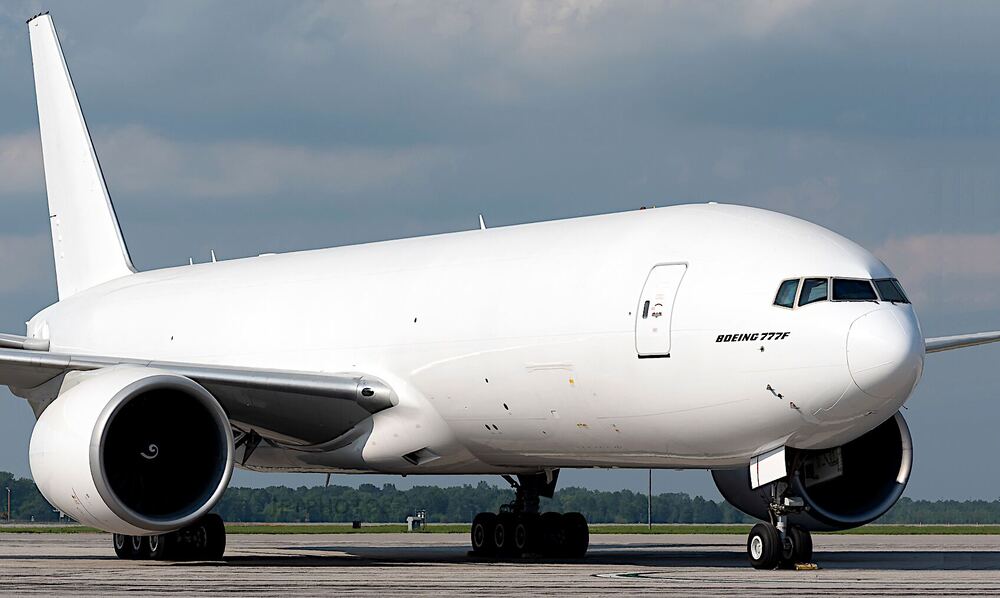
Twin-engine long-haul freighter used for 777F cargo charters to and from Australia
    24/7 Operations Desk · Active Now

    Freighter Charter · Boeing 777F

    777F Charter Australia: The Efficient Long-Haul Freighter

    Approximately 102 tonnes of payload on a modern twin, usually the most cost-effective aircraft for palletised, high-value, time-critical cargo moving to or from Australia.

    Already have an RFQ prepared? Email charters@aviall.com.au

    ~102 t
    Max structural payload
    ~4,900 nm
    Range at full payload
    Twin
    Lower cost per tonne
    24/7
    Cargo charter desk

    Why the 777F is the default for Australian charter freight

    Most cargo that justifies a charter to or from Australia is not outsize. It is palletised, dense, valuable and on a deadline, electronics and server hardware, pharmaceuticals, automotive and aerospace parts, perishables, project spares. For that profile the 777F is usually the commercially correct aircraft, and asking for a 747F by default is one of the more expensive mistakes a shipper can make.

    As a modern twin, the 777F delivers roughly 102 tonnes of maximum structural payload with materially lower fuel burn and operating cost than four-engine types. On a repeat programme, where cost per tonne over many rotations is the deciding number, that difference compounds.

    The trade-off is loading geometry. The 777F loads through a large main-deck side cargo door and has no nose door, so it is optimised for pallets and containers rather than extreme-length pieces. If a single piece will not turn into a side door, you are looking at a 747F /747f-charter-australia or an outsize lifter /an-124-charter-australia instead.

    • Max structural payload, approximately 102 tonnes
    • Range, approximately 4,900 nm at full payload, considerably more at lighter loads
    • Loading, large main-deck side cargo door; no nose door
    • Deck, standard aviation pallets and containers, fast to load and turn

    Payload versus range on Australian sectors

    Australia is a long-sector market, and on a 777F the payload–range trade is the number that decides whether a charter works non-stop. From North and Southeast Asia, Hong Kong, Shanghai, Singapore, Seoul, Tokyo, Bangkok, Ho Chi Minh City, east-coast Australian gateways sit comfortably within a commercially useful payload band, which is why these are the busiest 777F charter corridors.

    From Europe, the Middle East and the Americas, expect either a technical stop or a reduced payload. Neither is unusual, and neither is a reason to abandon a 777F: a fuel stop can be cheaper than upsizing the aircraft. What matters is that the trade is calculated during quoting rather than discovered on the day, which requires an accurate weight figure from you up front.

    Density is the other half of the equation. A 777F can run out of volume before it runs out of payload on light, bulky freight. If your cargo is voluminous rather than heavy, tell us the cube. It may change the recommended type entirely.

    Gateways, curfews and handling

    A 777F is straightforward to handle at every Australian international gateway, and side-door loading needs less specialised equipment and less ramp time than nose loading. The operational constraints that remain are scheduling ones.

    Sydney's night curfew is the most common cause of a slipped arrival window. Melbourne, Brisbane and Perth run without curfews and are frequently the better choice when the shipment must clear and be trucked overnight. Perth is often the cheapest gateway for west-coast and mining destinations even when the cargo originates in Asia, because the domestic leg, not the international one, is where cost quietly accumulates.

    • SYD, largest inbound volume; night curfew affects late arrivals
    • MEL, BNE, PER, curfew-free, better for overnight clearance and onward trucking
    • PER, usually lowest total cost for Western Australian and mining destinations
    • Price the international and domestic legs together, never in isolation

    What a 777F quote needs from you

    Origin, destination, total weight and readiness date are enough to get aircraft options back. Everything below sharpens an indicative price into a firm one.

    Already have an RFQ, packing list or dimension schedule? Paste or upload it (/submit-rfq?type=cargo) or email it to Charters@Aviall.com.au. We will work from your format rather than asking you to retype it.

    • Total weight and total cube, or pallet count and pallet type
    • Largest single piece dimensions, so loadability is confirmed before pricing
    • Readiness date, and any hard deadline at the destination
    • Temperature, security or handling requirements
    • Dangerous goods classification and whether documentation is already prepared
    • Whether the movement is one-off or the first of a series

    How we price a 777F charter

    Right-sizing first

    We compare the 777F against A330F, 767F and 747F options for your actual weight and cube, and recommend the cheapest type that can genuinely do the job.

    Payload–range calculated up front

    Sector length, technical stops and payload trades are worked out during quoting so the departure plan holds on the day.

    Handling and clearance planned with the flight

    Slots, curfews, out-of-hours handling, customs and quarantine coordination are part of the quote, not an afterthought.

    Programme pricing available

    For repeat rotations we price a programme instead of quoting each flight under deadline pressure, which usually improves both rate and availability.

    Live requirement

    Have a live cargo requirement?

    Send the six details below and our charter desk returns aircraft options, payload feasibility and an indicative wheels-up window. Partial information is enough to start. We will work with what you have while packing is finalised.

    Already have an RFQ? Email charters@aviall.com.au

    Send us

    • 01OriginAirport, city or plant
    • 02DestinationFinal airport or door address
    • 03PayloadGross weight and piece count
    • 04Ready dateWhen cargo is packed and released
    • 05CommodityIncluding any dangerous goods class
    • 06Packing listDimensions per piece, if available

    Urgent charter? Our ops desk is staffed 24/7.

    Aircraft options within the hour and a written quote with an indicative wheels-up window.

    Mission examples · Illustrative

    What this looks like in operation

    Representative mission profiles drawn from recurring work. Identifying details, operators, hospitals, routes, aircraft tail numbers, are intentionally omitted.

    AOG · Time critical

    Replacement engine to a wide-body grounded overseas

    A major carrier had a wide-body grounded at a foreign hub, awaiting a replacement engine sitting in a domestic MRO. Aviall positioned a freighter to the MRO, coordinated dangerous goods documentation for the engine and stand, and held a flight-following bridge with the airline's tech ops cell door-to-door.

    Outcome

    Engine wheels-up inside 14 hours of release; aircraft returned to service the next operational day.

    Pharma · Cool chain

    Temperature-controlled biologics on a single-shipper aircraft

    A global health programme required a high-value biologics consignment moved on a controlled cool-chain into the Asia-Pacific without consolidation risk. Aviall chartered a freighter dedicated to the shipment, with active containers, written ramp-time targets, and continuous data-logger oversight.

    Outcome

    Zero temperature excursions; chain-of-custody documentation closed within 24 hours of landing.

    777F quick reference

    Max structural payload
    Approximately 102 tonnes
    Range at full payload
    Approximately 4,900 nm
    Loading
    Large main-deck side cargo door
    Deck configuration
    Standard aviation pallets and containers
    Nose loading
    Not available, use a 747F for long single pieces
    Typical Australian gateways
    SYD, MEL, BNE, PER, DRW, ADL
    Common alternatives
    A330F, 767F, MD-11F, 747F
    Aircraft options returned
    Target within 60 minutes of a formed enquiry

    FAQ

    Frequently Asked Questions

    Maximum structural payload is approximately 102 tonnes. Usable payload on a specific charter is lower and depends on sector length, fuel, airport performance limits and cargo density, a light, bulky load will fill the deck volume before it reaches the weight limit.

    Have palletised cargo on a deadline?

    Send origin, destination, weight and readiness date. We compare the realistic freighter types for your dates and come back with options and an indicative price, usually within the hour.

    Have a live requirement?

    Send us origin, destination, payload and ready date. We return aircraft options. Attach an existing RFQ, packing list or photos straight from your phone, partial detail is enough to start.

    Requirement

    Cargo

    AttachmentsPacking list, cargo dimensions, manifest, RFQ document, images or other supporting documentation. Files up to 20MB each, 10 max. PDF, Word, Excel, CSV, images or email files.

    Goes straight to our charter desk at Charters@Aviall.com.au. Submitting an RFQ does not confirm an aircraft.