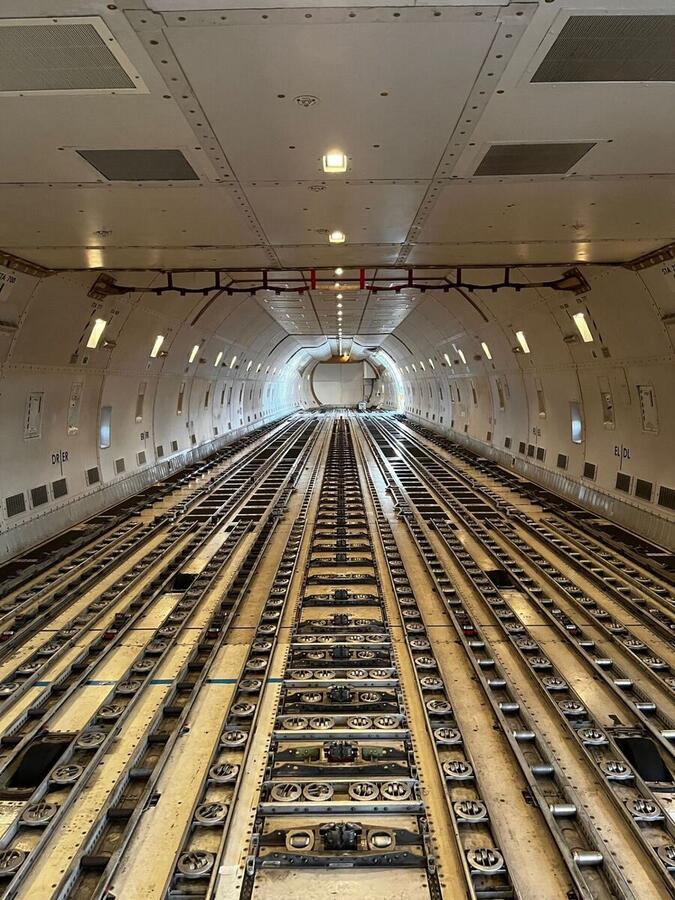
Cargo hold of a narrowbody 737 freighter loaded with palletised regional cargo
    24/7 Operations Desk · Active Now

    Main-Deck Freighter · Regional & Domestic Cargo

    Boeing 737 Freighter: Narrowbody Regional Workhorse

    Available across the 737-400F and 737-800BCF (converted freighter) family, this narrowbody is the practical choice for regional and domestic palletised cargo.

    Already have an RFQ prepared? Email charters@aviall.com.au

    ~20 t
    Typical max payload
    Narrowbody
    Regional access
    ~2,000 nm
    Approx. range at payload
    24/7
    Cargo desk

    What the 737 Freighter is built for

    The Boeing 737 Freighter family, including the older purpose-built 737-400F and the more recent 737-800BCF (Boeing Converted Freighter), is the narrowbody backbone of regional and domestic air cargo. It is chosen for e-commerce and express networks, domestic distribution and shorter regional sectors where a widebody freighter's capacity is not needed.

    Because specifications differ between variants, the 737-800BCF generally offers meaningfully more payload and volume than the older 737-400F. We confirm the specific sub-type and configuration against your cargo before quoting.

    Approximate payload and loading

    Typical maximum structural payload across the 737 Freighter family is generally in the order of 18–23 tonnes, with the 737-800BCF towards the higher end and the 737-400F towards the lower end. Loading is through a main-deck side cargo door onto standard aviation pallets or containers sized for narrowbody freighters.

    As a narrowbody, cargo hold height and width are more constrained than a widebody freighter, so palletised freight is generally lower-profile than main-deck cargo on a 767F or larger type.

    • Typical max payload, approximately 18–23 tonnes, varies by variant (737-400F vs 737-800BCF)
    • Loading, main-deck side cargo door
    • Deck, narrowbody pallets/containers, lower profile than widebody freighters
    • Best for, regional and domestic palletised cargo

    Approximate range and airfield access

    Range at typical payload is generally in the order of 1,800–2,200 nautical miles, comfortably covering most domestic Australian and regional Asia-Pacific sectors. Its narrowbody footprint allows it to operate into a wider range of regional airports than a widebody freighter, which is often the deciding factor for regional distribution networks.

    Because runway and apron requirements are generally lighter than a widebody, the 737F family is frequently the practical choice for connecting secondary and regional airfields into a wider freight network.

    Aircraft characteristics and considerations

    The 737-800BCF, being a more recent conversion of a newer passenger airframe, generally offers better fuel efficiency and payload than the older 737-400F, though both remain in active service across the region. Ground handling requirements are modest compared with widebody freighters, which can speed up turnarounds on multi-leg regional runs.

    As with any freighter, dangerous-goods acceptance, floor loading and specific door dimensions should be confirmed against the individual airframe offered for your mission.

    Typical use cases and related aircraft

    The 737 Freighter family suits regional and domestic palletised cargo, express and e-commerce distribution, and shorter charter legs where a widebody is unnecessary. For larger volumes or longer range, the [Boeing 767 Freighter]/aircraft-guide/boeing-767f is a natural step-up; for short-strip regional access with smaller loads, the [ATR 72 Freighter]/aircraft-guide/atr-72f may be more appropriate.

    Send us your cargo profile and route and we will confirm the right 737F variant and quote it against the actual airframe available.

    Verified specifications

    Boeing 737 Freighter payload, volume, range and loading

    The figures below are published structural and design maxima. They are not a guaranteed charter payload. What a specific airframe can actually lift on your sector depends on routing and sector length, fuel uplift, temperature and weather, runway length and pavement strength, altitude, cargo geometry and density, the operator's configuration and the individual aircraft's condition and weight variant. Achievable payload is confirmed against a nominated airframe and route before a charter is committed.

    Payload, volume and range

    Maximum payload
    Approximately 22,700 kg (50,070 lb) maximum revenue payload on the 737-800BCF.
    Cargo volume
    Around 141 m³ on the main deck plus lower-hold bulk capacity.
    Range at high payload
    Approximately 2,025 nm (3,750 km) maximum design range.
    Main deck
    Narrowbody main deck with a powered handling system, taking single-row pallets up to roughly 2.2 m high at the door.
    Airfield considerations
    Regional and international airports with a main-deck loader; far less demanding than widebody freighters.

    Cargo doors and loading

    Main-deck side door
    3.58 m wide x 2.20 m high clear opening
    Forward belly door
    1.22 m wide x 0.89 m high
    Aft belly door
    1.22 m wide x approximately 0.79–0.89 m high
    Nose loading
    None, side-door loading only.

    Pallet and ULD capability

    • 11 pallets at 88 x 125 in, or 10 at 96 x 125 in
    • Mixed layouts with an engine stand position available
    • Belly holds are bulk-loaded

    Cargo this type suits

    • Urgent regional freight and express
    • Aircraft engines on stands and AOG spares
    • Mining consumables and remote-site resupply

    Operational strengths

    • Lowest-cost jet freighter for regional Australian and near-neighbour sectors
    • Can serve airports too small for widebody freighters
    • Fast to mobilise for AOG and time-critical work

    Limitations to plan around

    • Limited payload and deck height
    • Range requires a technical stop on longer international lanes
    • Not suitable for outsize or very heavy single pieces

    Typical charter applications

    • Domestic Australian freighter charter
    • AOG and engine movements
    • Overnight express and courier support

    Specification sources

    • Boeing 737-800BCF specification sheet
    • Boeing Next-Generation 737 Airplane Characteristics for Airport Planning (D6-58325-7)

    What we coordinate on every Boeing 737 Freighter mission

    Aircraft selection

    Type chosen against payload, geometry, range and airfield infrastructure, not availability alone.

    Load engineering

    Lashing design, centre-of-gravity and floor loading checks against the actual airframe.

    Airfield analysis

    Runway length, pavement classification and obstacle clearance at both ends.

    Ground operation

    Cranes, K-loaders, low-loaders and inland movement planned end to end.

    Permits & customs

    Overflight, landing and dangerous-goods clearances arranged for the route.

    24/7 cargo desk

    Aircraft options within the hour for time-critical and AOG-driven freight.

    Urgent charter? Our ops desk is staffed 24/7.

    Aircraft options within the hour and a written quote with an indicative wheels-up window.

    Aircraft options

    Need this aircraft class?

    Send origin, destination, payload, dimensions or CBM and your ready date. Attach a packing list or existing RFQ if you have one, partial detail is enough for us to come back with aircraft options and an indicative structure for the 737 Freighter class and the realistic alternatives.

    Requirement

    Cargo

    AttachmentsPacking list, cargo dimensions, manifest, RFQ document, images or other supporting documentation. Files up to 20MB each, 10 max. PDF, Word, Excel, CSV, images or email files.

    Goes straight to our charter desk at Charters@Aviall.com.au. Submitting an RFQ does not confirm an aircraft.

    Sending a requirement does not reserve or confirm an aircraft. Freighter availability, achievable payload and permits are confirmed against a specific airframe, route and date before anything is committed.

    Boeing 737 Freighter at a glance

    Type
    Narrowbody regional freighter
    Typical max payload
    ~18–23 tonnes (varies by variant)
    Loading
    Main-deck side cargo door
    Approx. range
    ~1,800–2,200 nm at typical payload
    Deck
    Narrowbody pallets/containers
    Best for
    Regional & domestic palletised cargo

    FAQ

    Frequently Asked Questions

    Both are 737 Freighters, but the 737-800BCF is a more recent conversion of a newer, larger passenger airframe and generally offers more payload and better fuel efficiency than the older purpose-built 737-400F. We confirm the specific variant for your quote.

    Need a 737 Freighter for regional cargo?

    Send us your cargo profile and route. We will confirm the right variant, engineer the load and quote it with an indicative wheels-up window, 24/7.

    Have a live requirement?

    Send us origin, destination, payload and ready date. We return aircraft options. Attach an existing RFQ, packing list or photos straight from your phone, partial detail is enough to start.

    Requirement

    Cargo

    AttachmentsPacking list, cargo dimensions, manifest, RFQ document, images or other supporting documentation. Files up to 20MB each, 10 max. PDF, Word, Excel, CSV, images or email files.

    Goes straight to our charter desk at Charters@Aviall.com.au. Submitting an RFQ does not confirm an aircraft.