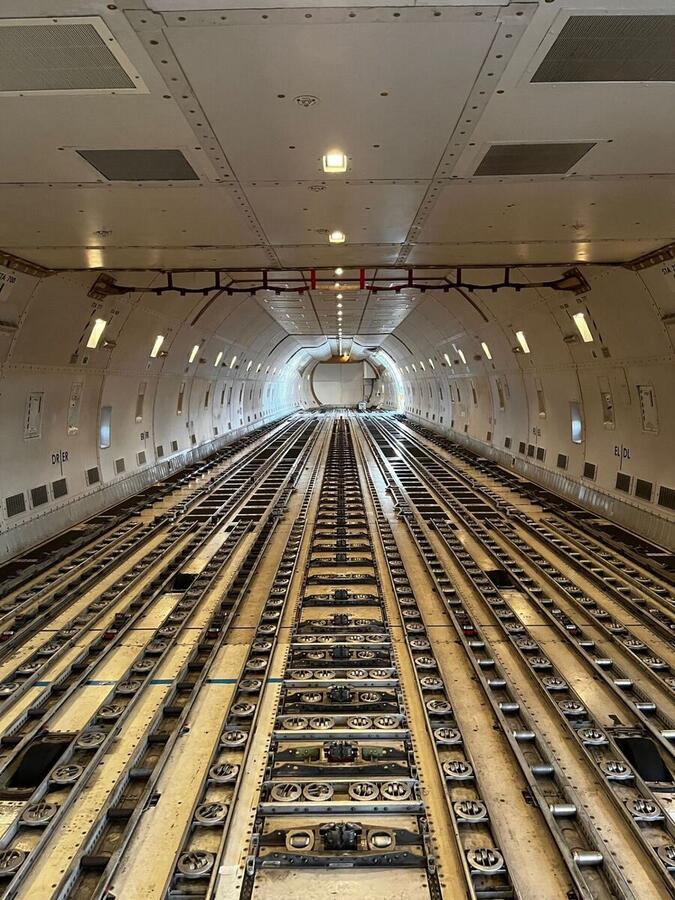
Cargo hold of a medium-widebody 767 freighter loaded with palletised air cargo
    24/7 Operations Desk · Active Now

    Main-Deck Freighter · Medium-Widebody Cargo

    Boeing 767 Freighter: The Efficient Medium-Widebody

    A widely operated twin-engine freighter, both purpose-built and passenger-to-freighter converted, that sits between narrowbody and large widebody capacity.

    Already have an RFQ prepared? Email charters@aviall.com.au

    ~52 t
    Typical max payload
    Twin
    Efficient operation
    ~3,200 nm
    Approx. range at payload
    24/7
    Cargo desk

    What the 767 Freighter is built for

    The Boeing 767 Freighter, available both as a factory-built freighter and as a passenger-to-freighter conversion, fills the gap between narrowbody freighters like the 737F and large widebodies such as the 777F. It is a common sight in express and general cargo networks because it balances a genuinely useful main-deck volume against efficient twin-engine operating costs.

    For general freight, e-commerce, regional distribution and time-sensitive cargo on medium-haul sectors, the 767F is one of the most frequently chartered medium-widebody freighters in the Asia-Pacific.

    Approximate payload and main-deck loading

    Depending on variant and configuration, the 767 Freighter typically carries a maximum structural payload in the order of 52–58 tonnes. It loads through a large main-deck side cargo door and accepts standard aviation pallets and containers rather than extreme-length single pieces, since it has no nose door.

    Converted freighters retain the passenger-era fuselage and floor structure reinforced for cargo, so exact main-deck pallet positions and floor loading limits vary between individual airframes and are confirmed against the specific aircraft offered.

    • Typical max payload, approximately 52–58 tonnes, varies by variant and operator
    • Loading, main-deck side cargo door, no nose door
    • Deck, standard aviation pallets and containers
    • Best for, general and time-sensitive cargo on medium-haul routes

    Approximate range and operational fit

    Range at typical payload is generally in the order of 3,000–3,500 nautical miles, comfortably covering most intra-Asia-Pacific and medium-haul intercontinental sectors. Its twin-engine efficiency generally makes it more economical per tonne on these distances than a larger four-engine freighter carrying a similar-sized load.

    Because the 767F is common in both freight and passenger-conversion fleets, availability across the region is generally good, which can help with faster positioning for time-critical charters.

    Aircraft characteristics and considerations

    As a mid-size widebody, the 767F needs less runway and apron space than a 747 or 777 freighter, widening the range of airfields it can use. Ground handling equipment requirements are broadly similar to other widebody freighters, though loader height and door sill dimensions should be checked against the individual airframe.

    Cargo suitability is generally palletised and containerised freight rather than outsize single pieces; for long single items requiring nose-door access, a 747-class freighter is required instead.

    Typical use cases and related aircraft

    The 767 Freighter is a strong fit for general and express cargo on medium-haul routes where a full-size widebody freighter is not required. For higher payload and longer range, the [Boeing 777F]/aircraft-guide/boeing-777f or [Airbus A330 Freighter]/aircraft-guide/airbus-a330f are natural step-ups; for smaller narrowbody loads, the [Boeing 737 Freighter]/aircraft-guide/boeing-737f is often more economical.

    Send us your cargo profile and route and we will confirm whether a 767F is the right fit and quote it against the actual aircraft available.

    Verified specifications

    Boeing 767 Freighter payload, volume, range and loading

    The figures below are published structural and design maxima. They are not a guaranteed charter payload. What a specific airframe can actually lift on your sector depends on routing and sector length, fuel uplift, temperature and weather, runway length and pavement strength, altitude, cargo geometry and density, the operator's configuration and the individual aircraft's condition and weight variant. Achievable payload is confirmed against a nominated airframe and route before a charter is committed.

    Payload, volume and range

    Maximum payload
    Around 50–58 tonnes depending on variant and whether the airframe is a production freighter or a converted BCF.
    Cargo volume
    Approximately 400–440 m³ across main deck and lower holds, varying by conversion programme.
    Range at high payload
    Medium-haul freighter; typically operated on regional Asia-Pacific sectors with a technical stop on longer lanes.
    Main deck
    Single-aisle-width main deck taking 88 x 125 in and 96 x 125 in pallets, with a powered handling system.
    Airfield considerations
    Most international and larger regional airports with main-deck loading equipment.

    Cargo doors and loading

    Main-deck side door (production freighter)
    3.40 m wide x 2.62 m high
    Forward lower door
    3.40 m wide x 1.70 m high
    Aft lower door (production freighter)
    3.40 m wide x 1.70 m high
    Aft lower door (BCF conversion)
    1.78 m wide x 1.75 m high
    Bulk door
    0.97 m wide x 1.14 m high
    Nose loading
    None, side-door loading only.

    Pallet and ULD capability

    • Main deck: around 24 pallet positions depending on layout
    • Lower holds: LD-2 class containers and bulk

    Cargo this type suits

    • Regional express and general freight
    • AOG and aerospace spares
    • Mining and industrial consumables

    Operational strengths

    • Right-sized for the majority of Asia-Pacific charter shipments
    • Widely available across express and ACMI operators
    • Lower charter cost than any widebody freighter above it

    Limitations to plan around

    • Door and deck height limit tall pieces
    • Conversion programmes differ, door sizes must be confirmed per airframe
    • Insufficient for heavy project or outsize cargo

    Typical charter applications

    • Regional freighter charters within APAC
    • Urgent replenishment and AOG recovery
    • Rotational programmes for forwarders

    Specification sources

    • Boeing 767 Airplane Characteristics for Airport Planning (D6-58328)
    • ANA Cargo 767F and 767BCF aircraft specifications

    What we coordinate on every Boeing 767 Freighter mission

    Aircraft selection

    Type chosen against payload, geometry, range and airfield infrastructure, not availability alone.

    Load engineering

    Lashing design, centre-of-gravity and floor loading checks against the actual airframe.

    Airfield analysis

    Runway length, pavement classification and obstacle clearance at both ends.

    Ground operation

    Cranes, K-loaders, low-loaders and inland movement planned end to end.

    Permits & customs

    Overflight, landing and dangerous-goods clearances arranged for the route.

    24/7 cargo desk

    Aircraft options within the hour for time-critical and AOG-driven freight.

    Urgent charter? Our ops desk is staffed 24/7.

    Aircraft options within the hour and a written quote with an indicative wheels-up window.

    Aircraft options

    Need this aircraft class?

    Send origin, destination, payload, dimensions or CBM and your ready date. Attach a packing list or existing RFQ if you have one, partial detail is enough for us to come back with aircraft options and an indicative structure for the 767 Freighter class and the realistic alternatives.

    Requirement

    Cargo

    AttachmentsPacking list, cargo dimensions, manifest, RFQ document, images or other supporting documentation. Files up to 20MB each, 10 max. PDF, Word, Excel, CSV, images or email files.

    Goes straight to our charter desk at Charters@Aviall.com.au. Submitting an RFQ does not confirm an aircraft.

    Sending a requirement does not reserve or confirm an aircraft. Freighter availability, achievable payload and permits are confirmed against a specific airframe, route and date before anything is committed.

    Boeing 767 Freighter at a glance

    Type
    Medium-widebody freighter
    Typical max payload
    ~52–58 tonnes (varies by variant)
    Loading
    Main-deck side cargo door
    Approx. range
    ~3,000–3,500 nm at typical payload
    Deck
    Standard aviation pallets & containers
    Best for
    General & time-sensitive cargo, medium-haul

    FAQ

    Frequently Asked Questions

    Typical maximum structural payload is around 52–58 tonnes depending on variant and configuration. We confirm the exact figure against the specific airframe offered for your charter.

    Need a 767 Freighter for medium-haul cargo?

    Send us your cargo profile and route. We will confirm whether a 767F is available and appropriate and quote it with an indicative wheels-up window, 24/7.

    Have a live requirement?

    Send us origin, destination, payload and ready date. We return aircraft options. Attach an existing RFQ, packing list or photos straight from your phone, partial detail is enough to start.

    Requirement

    Cargo

    AttachmentsPacking list, cargo dimensions, manifest, RFQ document, images or other supporting documentation. Files up to 20MB each, 10 max. PDF, Word, Excel, CSV, images or email files.

    Goes straight to our charter desk at Charters@Aviall.com.au. Submitting an RFQ does not confirm an aircraft.